Introduction
Artificial intelligence is transforming how businesses build, deploy, and operate applications. From generative AI assistants and intelligent automation to predictive analytics and machine learning platforms, organisations are increasingly integrating AI into their business applications to improve productivity, customer experiences, and operational efficiency.
However, this transformation comes with a significant challenge: managing the cost of AI-powered cloud infrastructure.
Traditional cloud cost management practices were designed primarily for predictable workloads, conventional applications, and relatively stable resource consumption. AI introduces a different financial landscape, characterised by fluctuating compute requirements, GPU-intensive workloads, model training expenses, inference costs, and unpredictable usage patterns.
This is where Cloud FinOps meets AI.
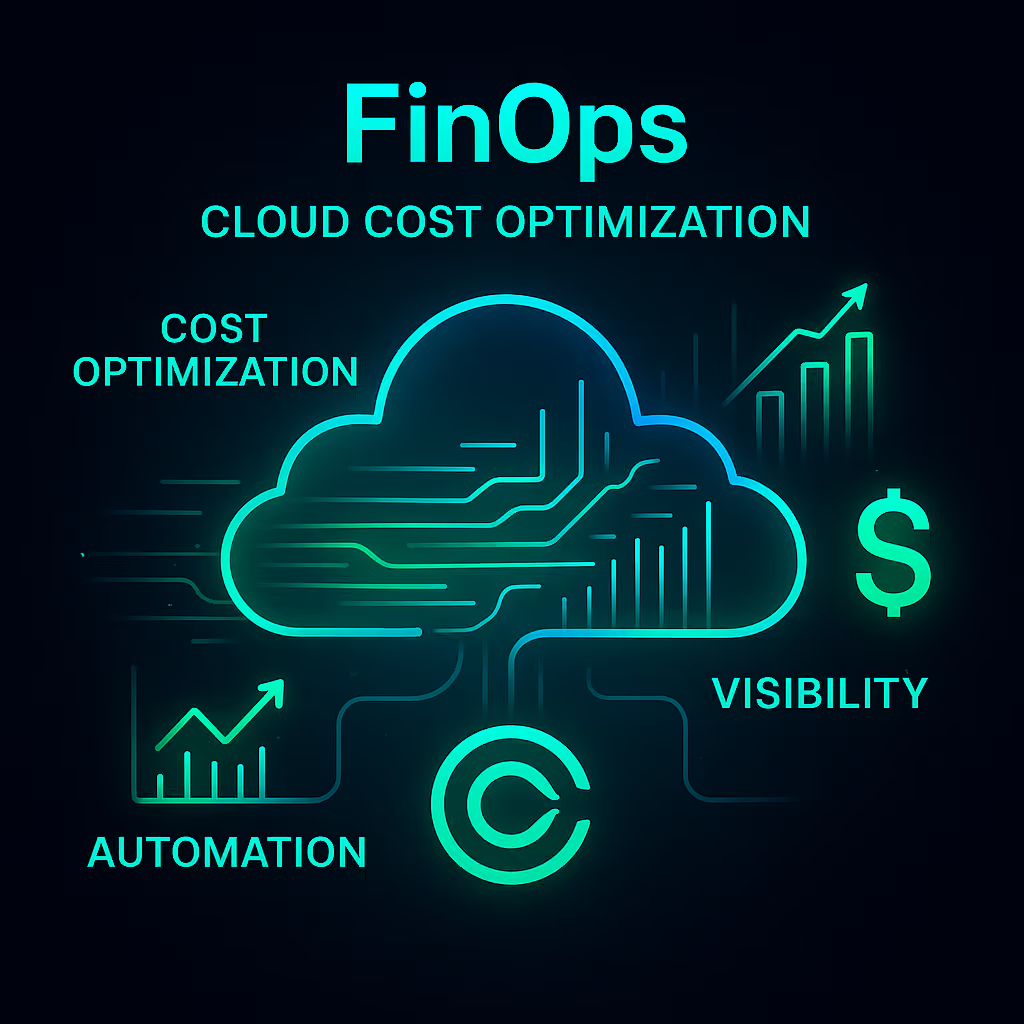
By combining financial accountability, cloud cost visibility, engineering efficiency, and intelligent automation, organisations can establish a sustainable approach to managing the financial impact of next-generation business applications.
The objective is not simply to reduce cloud spending. It is to maximise the business value generated by every investment in cloud and artificial intelligence.
What Is Cloud FinOps and Why Does AI Make It More Important?
Cloud FinOps is an operational framework that brings finance, technology, and business teams together to manage cloud expenditure while maximising business value.
It encourages organisations to understand where their cloud money goes, who is responsible for spending, and whether infrastructure investments deliver measurable returns.
When AI enters the picture, FinOps becomes even more important.
Unlike traditional applications, AI-powered workloads can consume substantial computing resources depending on model complexity, data volume, inference frequency, and user demand. For example, a business deploying a generative AI chatbot may experience significant increases in infrastructure costs as the number of customer interactions grows.
Similarly, training large machine learning models can require expensive GPU resources, specialised infrastructure, and extensive data processing.
Several factors make AI cloud spending more challenging:
- GPU-intensive computing: AI training and inference frequently require specialised hardware that can be more expensive than conventional CPU-based infrastructure.
- Unpredictable workloads: AI application usage can fluctuate depending on customer demand, business activity, and automated processes.
- Model complexity: Larger models and sophisticated AI architectures can increase computational requirements.
- Data processing expenses: Preparing, storing, transferring, and processing large datasets adds to overall cloud expenditure.
- Continuous experimentation: AI development involves testing models, evaluating performance, and running multiple experiments, which can increase infrastructure consumption.
Without appropriate financial controls, organisations risk investing heavily in AI infrastructure without understanding its actual business contribution.
How AI Is Changing the Cost Structure of Business Applications
The next generation of business applications is increasingly intelligent, automated, and data-driven. AI capabilities are becoming embedded in enterprise software, customer platforms, analytics solutions, and internal business processes.
This changes how organisations calculate and manage application costs.
1. Higher Infrastructure and Computing Costs
AI applications often require more computing power than traditional business software.
For instance, an enterprise application using machine learning to analyse customer behaviour may require continuous data processing and model inference. A generative AI application may additionally depend on GPU-based infrastructure to generate responses.
These requirements can increase infrastructure expenditure, particularly when workloads are not optimised.
2. Model Training and Inference Expenses
AI costs generally involve two important activities: model training and inference.
Model training involves teaching an AI model using datasets, while inference refers to using the trained model to generate predictions or responses.
Both activities have different cost structures.
Training can involve intensive computing over extended periods, while inference costs accumulate with application usage. A business application serving thousands of daily users may generate substantial recurring inference expenses.
Organisations therefore need to evaluate both development and operational costs when planning AI investments.
3. Data Storage and Network Costs
AI applications depend on large amounts of data. Organisations must store, process, retrieve, and transfer this information across cloud environments.
Data pipelines, vector databases, backups, and inter-region data transfers can introduce additional expenses.
These costs are sometimes overlooked when businesses focus exclusively on GPU consumption or model pricing.
4. Increased Operational Complexity
AI-powered applications frequently integrate multiple cloud services, APIs, databases, and third-party AI models.
Managing these interconnected components requires better visibility into resource consumption.
Without centralised cost monitoring, organisations may struggle to identify which application, team, model, or business process is driving expenditure.
Key Cloud FinOps Strategies for Managing AI Costs
Managing AI-related cloud expenditure requires a combination of financial governance, engineering optimisation, and continuous monitoring.
The following strategies can help organisations establish effective FinOps practices.
1. Establish Comprehensive AI Cost Visibility
The first step is understanding where money is being spent.
Organisations should implement cloud cost monitoring systems that provide visibility into infrastructure usage, AI model consumption, storage expenses, and data transfer charges.
Costs should be allocated across departments, projects, applications, and AI workloads.
For example, an organisation operating multiple AI-powered business applications should be able to identify the cost of each application independently.
This enables finance and technology teams to understand spending patterns and make informed decisions.
2. Implement AI Workload Optimisation
Not every AI application requires the most powerful available model or infrastructure.
Businesses should evaluate workload requirements before selecting computing resources.
Practical optimisation techniques include:
- Selecting appropriately sized GPU and CPU resources.
- Using smaller models for simpler business tasks.
- Applying model quantisation and compression where appropriate.
- Optimising prompts to reduce unnecessary token consumption.
- Using caching to avoid repeated processing.
- Scaling infrastructure according to actual workload demand.
These measures can help improve application efficiency without compromising business outcomes.
3. Introduce Intelligent Resource Allocation
AI workloads often experience fluctuating demand. Running infrastructure continuously at maximum capacity can lead to unnecessary spending.
Organisations should use automated scaling policies to adjust computing resources according to application requirements.
For example, a customer support AI platform may experience higher usage during business hours. Infrastructure can scale according to demand rather than maintaining unnecessary capacity throughout the day.
Resource scheduling, automated shutdown policies, and workload prioritisation can further improve utilisation.
4. Establish Financial Accountability Across Teams
Cloud FinOps is not exclusively an IT responsibility.
Finance, engineering, procurement, and business teams must collaborate to manage AI expenditure effectively.
Organisations should establish clear budget ownership and define spending responsibilities for individual AI projects.
Useful practices include:
- Setting departmental cloud budgets.
- Creating cost allocation policies.
- Monitoring spending against approved limits.
- Establishing automated budget alerts.
- Reviewing AI infrastructure expenditure regularly.
This approach encourages teams to consider financial implications during application development rather than after deployment.
5. Measure AI Costs Against Business Value
Reducing cloud expenditure should never come at the expense of business performance.
Organisations must understand whether AI investments deliver measurable outcomes.
Instead of tracking infrastructure costs alone, businesses should evaluate metrics such as cost per AI request, cost per successful transaction, cost per customer interaction, and operational savings generated through automation.
For example, an AI-powered customer service application may have higher infrastructure expenses but significantly reduce manual support requirements.
The real objective is to measure the financial return generated by the application, not simply minimise its operating budget.
How AI Can Improve Cloud FinOps Management
Interestingly, AI is not just increasing cloud expenditure. It can also help organisations manage cloud financial operations more effectively.
When implemented appropriately, AI-driven FinOps tools can analyse large volumes of infrastructure data, identify spending patterns, and recommend optimisation opportunities.
Predictive Cloud Cost Forecasting
AI-powered analytics can examine historical cloud usage, seasonal demand, and workload patterns to forecast future infrastructure expenses.
This helps finance and technology teams anticipate spending increases and plan budgets more accurately.
For example, predictive models can identify periods when application traffic is likely to increase, allowing organisations to prepare infrastructure capacity and financial resources in advance.
Automated Anomaly Detection
Unexpected cloud spending can quickly affect operational budgets.
AI-based anomaly detection can identify unusual resource consumption, sudden increases in GPU usage, and unexpected API requests.
Automated alerts help teams investigate potential issues before they become significant financial problems.
Intelligent Cost Optimisation
AI can analyse infrastructure utilisation and identify underused resources, inefficient workloads, and opportunities for better resource allocation.
It can also support recommendations involving instance sizing, workload scheduling, and infrastructure scaling.
However, automated recommendations should be validated against application performance, security, and availability requirements before implementation.
Common Challenges in Implementing AI-Driven FinOps
Despite its potential benefits, integrating AI into cloud financial management presents several challenges.
Lack of cost transparency: AI expenditure can be distributed across cloud infrastructure, external APIs, model providers, and data services, making accurate cost allocation difficult.
Limited expertise: Effective AI FinOps requires knowledge of cloud architecture, financial management, machine learning, and application engineering.
Rapidly changing technology: New models, infrastructure options, and pricing structures continuously change the economics of AI deployment.
Balancing performance and cost: Aggressive cost optimisation can negatively affect response times, model accuracy, and application reliability.
Governance and compliance: Organisations must consider data protection, access controls, regulatory requirements, and responsible AI practices when managing AI workloads.
Addressing these challenges requires a structured FinOps framework supported by collaboration, reliable data, and clearly defined governance policies.
Best Practices for Building a Future-Ready AI FinOps Framework
Organisations planning to scale AI-powered business applications should establish a framework that connects technology investments with financial outcomes.
The following practices provide a practical starting point:
- Start with cost visibility: Monitor spending across cloud infrastructure, AI models, APIs, storage, and data processing.
- Define financial ownership: Assign clear budget responsibilities to engineering, finance, and business teams.
- Introduce cost-efficient architecture: Select AI models and infrastructure based on actual application requirements.
- Automate monitoring: Use intelligent alerts, anomaly detection, and predictive forecasting to identify financial risks.
- Establish performance benchmarks: Track application latency, availability, model quality, and resource utilisation alongside expenditure.
- Review investments regularly: Evaluate AI workload costs and business outcomes to identify opportunities for improvement.
- Build governance into development: Integrate cost monitoring and financial accountability into application design, testing, and deployment.
These practices help organisations move beyond reactive cloud cost reduction towards proactive financial management.
The Future of Cloud FinOps in an AI-Driven Business Environment
As AI adoption accelerates, cloud financial management will become an increasingly important part of enterprise technology strategy.
Business applications will continue evolving through generative AI, autonomous agents, intelligent workflows, and advanced analytics. Each development introduces new infrastructure requirements and financial considerations.
Traditional cloud cost dashboards alone may not provide sufficient insight into these increasingly complex environments.
Future FinOps practices will likely place greater emphasis on real-time cost attribution, automated optimisation, AI workload governance, and business-value measurement.
Organisations will also need to understand the economics of AI agents, particularly when automated systems perform multiple tasks, interact with external services, and generate recurring model inference costs.
The organisations that succeed will be those that treat financial accountability as an integral part of AI application development rather than an afterthought.
Ultimately, Cloud FinOps and AI must work together to make innovation financially sustainable.
Frequently Asked Questions (FAQs)
1. What is Cloud FinOps in AI?
Cloud FinOps in AI is the practice of managing, monitoring, and optimising cloud expenditure associated with artificial intelligence workloads. It combines financial accountability, cloud cost visibility, and engineering optimisation to maximise the value of AI investments.
2. Why are AI applications expensive to run in the cloud?
AI applications can be expensive because they require specialised computing resources, GPU infrastructure, model training, inference processing, data storage, and network bandwidth. Costs also increase with application usage and model complexity.
3. How can businesses reduce AI infrastructure costs?
Businesses can reduce AI infrastructure costs by selecting efficient models, optimising GPU utilisation, implementing automated scaling, using caching, monitoring token consumption, and identifying underutilised resources.
4. How does AI improve FinOps?
AI improves FinOps through predictive cost forecasting, automated anomaly detection, intelligent resource allocation, and infrastructure optimisation. These capabilities help organisations identify spending inefficiencies and make informed financial decisions.
5. What KPIs should organisations track for AI FinOps?
Important KPIs include cost per AI request, cost per inference, GPU utilisation, cloud spending per application, cost per transaction, infrastructure utilisation, and return on AI investment.
Conclusion
The growing adoption of artificial intelligence is changing how organisations develop, deploy, and manage business applications. While AI creates opportunities for innovation and operational efficiency, it also introduces new financial complexities that traditional cloud cost management approaches may not adequately address.
Cloud FinOps provides the foundation for managing these challenges by connecting financial accountability with engineering decisions and business objectives.
By improving cost visibility, optimising AI workloads, automating resource management, and measuring financial outcomes, organisations can build a sustainable approach to AI adoption.
The future of enterprise AI is not just about building smarter applications. It is about building smarter applications that deliver measurable business value at a sustainable cost.