Introduction
The B2B software buying journey has changed significantly. Buyers no longer depend on sales representatives to introduce products, explain features or provide basic information about software solutions. Instead, they increasingly conduct independent research, compare vendors and evaluate product capabilities before initiating a sales conversation.
From Google searches and software review platforms to industry communities, comparison websites and AI-powered search tools, buyers now have access to multiple sources of information. They can explore product features, compare pricing models, read customer experiences and shortlist potential vendors without directly interacting with a sales team.
This shift is changing how software companies approach product discovery, digital marketing and customer acquisition. Businesses must now build visibility across the digital channels where potential customers research solutions and form purchasing preferences.
Recent research highlights the scale of this transformation. Gartner’s 2026 survey of 645 B2B buyers found that 45% had used generative AI during a recent purchase, primarily to research vendors and products. The same research found that 70% preferred a completely digital self-service buying experience.
The message is clear: B2B product discovery increasingly begins before sales engagement.
For software companies, understanding how buyers research products is essential to building trust, attracting qualified prospects and influencing purchasing decisions.
Let’s explore how B2B product discovery is evolving, the channels buyers use to research software and what businesses can do to remain visible throughout the buying journey.
What Is B2B Product Discovery?
B2B product discovery refers to the process through which business buyers identify, explore, compare and evaluate software products or services before making a purchasing decision.
It involves researching business challenges, understanding available solutions, comparing vendors and assessing whether a product meets specific operational requirements.
Unlike traditional sales-led discovery, where representatives introduce products and guide potential customers through the initial evaluation, modern B2B product discovery is increasingly buyer-driven.
Buyers independently gather information from multiple sources before deciding which vendors deserve further consideration.
For example, a company looking for a new customer relationship management (CRM) platform may:
- Search Google for CRM software solutions.
- Explore comparison articles and software review platforms.
- Watch product demonstrations and tutorials.
- Ask industry peers for recommendations.
- Use AI tools to compare software capabilities.
- Visit vendor websites to review pricing, integrations and product documentation.
- Shortlist potential providers before requesting a product demonstration.
By the time the company contacts a sales representative, its buying team may already understand the available solutions and have a preferred vendor.
This makes product discovery an important part of the overall B2B buying journey.
Why Is B2B Product Discovery Changing?
Several factors are influencing how businesses research and evaluate software products.
1. Buyers Want Greater Control Over the Research Process
Modern B2B buyers prefer to gather information independently before engaging with vendors.
They want to understand product capabilities, pricing structures and implementation requirements without feeling pressured to speak with a sales representative.
Gartner’s June 2025 research found that 61% of B2B buyers preferred an overall rep-free buying experience. Its May 2026 survey reported that 67% preferred a sales rep-free experience.
These findings highlight the importance of providing accessible and useful product information throughout the discovery process.
Software companies that make essential information difficult to access may create unnecessary friction for potential customers.
2. More Digital Information Sources Are Available
Buyers can now research software through several digital channels.
These include:
- Search engines such as Google and Bing
- Software review platforms such as G2 and Capterra
- Industry publications and technology blogs
- LinkedIn and professional communities
- YouTube product demonstrations
- Vendor websites and documentation
- AI-powered search and conversational tools
- Industry forums and peer recommendations
Each channel provides a different perspective on a product.
For example, a vendor website may explain technical capabilities, while customer reviews provide insights into usability and implementation experiences.
Buyers combine these sources to develop a more complete understanding before making contact.
3. AI Is Changing How Buyers Discover Software
Generative AI tools are introducing new ways to research business software.
Instead of manually opening multiple websites, buyers can ask AI assistants to explain product categories, compare software capabilities and summarise technical differences.
For example, a buyer researching enterprise resource planning (ERP) software may ask an AI assistant to compare solutions based on deployment options, integration capabilities, pricing models and industry suitability.
AI can help organise large amounts of information into more accessible answers.
However, AI-generated recommendations are not automatically accurate or complete. Buyers still need to verify product claims through vendor documentation, customer experiences and direct product evaluation.
Gartner’s 2026 survey found that 45% of respondents had used generative AI during a recent purchase. It also found that 69% preferred to validate AI-generated insights with sales representatives.
This indicates that AI is becoming part of the research process while human expertise remains important for validating critical information.
4. Buying Decisions Involve Multiple Stakeholders
B2B software purchases rarely involve just one individual.
Depending on the product and organisation, the buying group may include:
- IT managers evaluating technical compatibility
- Department heads assessing business requirements
- Finance teams reviewing costs and budgets
- Procurement teams evaluating vendors and contracts
- Security teams assessing data protection and compliance
- Business executives approving strategic investments
Each stakeholder researches the product from a different perspective.
For example, an IT manager may focus on API availability and system architecture, while a finance manager may prioritise subscription costs and return on investment.
Software companies must therefore provide information that addresses the needs of different decision-makers.
How B2B Buyers Research Software Before Talking to Sales
The modern software discovery process involves several research activities. Buyers move between digital channels, compare available information and gradually narrow their options.
Here are the key ways B2B buyers discover and evaluate software.
1. Search Engines Remain a Major Discovery Channel
Search engines are often among the first places buyers visit when researching a business problem or looking for software solutions.
They use specific search queries to identify products, understand features and compare available options.
Common B2B software search queries include:
- Best CRM software for small businesses
- ERP software comparison
- Cloud-based accounting software
- Best project management tools for enterprises
- Alternatives to a specific SaaS platform
- Software integration solutions for manufacturing
These searches reveal different levels of buying intent.
A person searching for “what is CRM software” may be exploring a category, while someone searching for “Salesforce alternatives for mid-sized businesses” may already be evaluating vendors.
This makes search engine optimisation (SEO) an important part of B2B product discovery.
Software companies should create content that addresses informational, comparative and transactional search intent.
Useful content formats include:
- Product category guides
- Software comparison articles
- Feature explanation pages
- Industry-specific solution pages
- Alternative and competitor comparison pages
- Integration guides
- Implementation resources
The objective is to help potential buyers find relevant information at different stages of their research.
2. Software Review Platforms Influence Vendor Evaluation
Review platforms have become important research destinations for B2B software buyers.
Websites such as G2, Capterra and TrustRadius provide customer reviews, product comparisons and information about software capabilities.
These platforms help buyers understand how products perform in real business environments.
Buyers commonly evaluate:
- Overall customer ratings
- User feedback and testimonials
- Product usability
- Customer support quality
- Implementation experience
- Integration capabilities
- Feature availability
- Pricing information
Reviews provide a perspective that vendor-created marketing materials cannot always offer.
For software companies, maintaining accurate product information and encouraging genuine customer feedback can strengthen credibility.
However, businesses should focus on authentic customer experiences rather than attempting to manipulate ratings or publish misleading testimonials.
3. Comparison Websites Help Buyers Shortlist Vendors
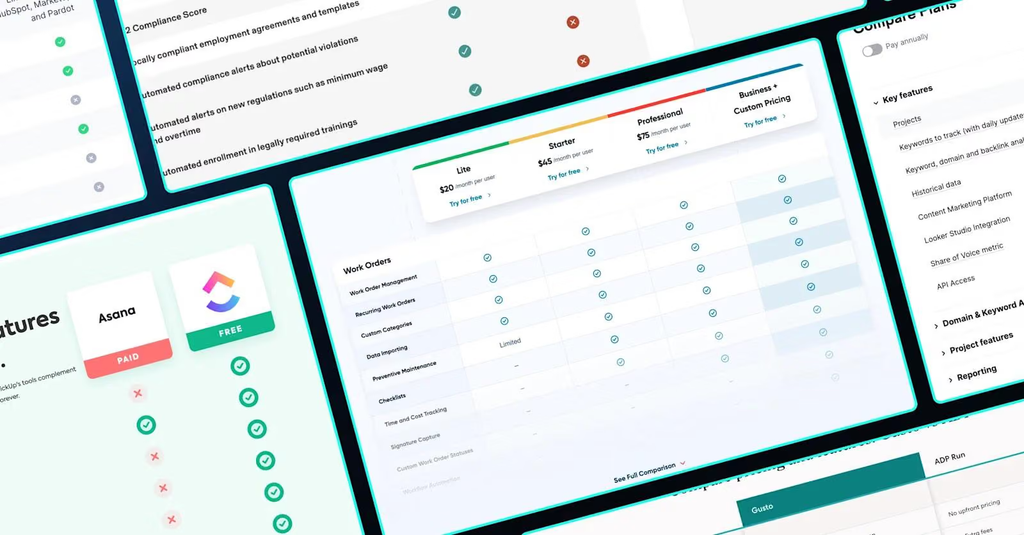
Comparison websites allow buyers to evaluate multiple software products against similar criteria.
These platforms often organise information into categories such as features, pricing, deployment options, integrations and customer ratings.
For example, a business comparing project management software may evaluate different providers based on:
- Task management capabilities
- Team collaboration features
- Reporting and analytics
- Workflow automation
- Integration with existing tools
- Subscription costs
- User experience
Comparison content helps buyers reduce the number of products they need to investigate in detail.
Software companies can support this process by publishing transparent feature comparisons, clear product specifications and relevant use cases.
4. AI Search and LLMs Are Creating New Discovery Opportunities
Large language models (LLMs) are becoming another channel through which buyers research software.
Tools such as ChatGPT, Google Gemini and Microsoft Copilot can help buyers explore product categories, understand technical concepts and identify potential vendors.
For example, a buyer might ask:
- Which CRM platforms support advanced workflow automation?
- What are the differences between cloud ERP and on-premises ERP?
- Which project management tools offer enterprise-level security?
- What should a business consider before selecting an API management platform?
AI assistants can summarise information from different sources and help buyers structure their research.
However, AI search does not eliminate the importance of traditional search engines, review platforms or vendor websites.
According to 6sense’s 2026 B2B Buyer Experience Report, 81% of buyers used LLMs during their evaluations, but only 26% used them specifically to discover vendors. The report also found that buyers continued to rely on vendor websites, existing knowledge and peer networks.
This distinction is important. AI tools may help buyers interpret and validate information without necessarily becoming their primary source for discovering new software providers.
For software companies, this creates an opportunity to improve their visibility across both traditional search and AI-generated answers.
5. LinkedIn and Professional Communities Support Peer Research
B2B software decisions often involve significant investment and operational changes.
Buyers therefore look beyond vendor marketing materials to understand how other professionals use a particular solution.
Professional communities and industry networks provide opportunities to gather practical insights.
Platforms such as LinkedIn allow buyers to:
- Follow software companies and industry experts
- Read professional recommendations
- Explore product discussions
- Discover customer experiences
- Participate in industry communities
- Learn about technology trends
Peer recommendations can help buyers understand whether a product is suitable for their business environment.
For software companies, sharing useful insights and participating in relevant industry discussions can improve brand familiarity and credibility.
6. Product Demonstrations and Video Content Help Buyers Understand Functionality
Written product descriptions can explain what software does, but visual demonstrations help buyers understand how it works.
Video content allows potential customers to explore interfaces, workflows and product capabilities without scheduling a sales call.
Common examples include:
- Product walkthroughs
- Feature demonstrations
- Setup tutorials
- Integration demonstrations
- Customer case studies
- Implementation guides
For example, a buyer researching workflow automation software may watch a demonstration showing how the platform connects applications and automates repetitive tasks.
This helps buyers assess product usability and technical suitability before speaking with a representative.
Software companies should make relevant demonstrations easy to find and avoid hiding every useful product resource behind a lead-generation form.
7. Vendor Websites Remain Central to Product Research
Although buyers use several external channels, vendor websites remain important sources of product information.
Once buyers discover a potential solution, they often visit the company’s website to verify product capabilities and understand whether the offering meets their requirements.
Important website elements include:
- Clear product descriptions
- Feature and functionality pages
- Transparent pricing information
- Technical documentation
- Integration directories
- Security and compliance information
- Customer success stories
- Product demonstrations
- Implementation details
A well-structured website helps buyers find answers without requiring immediate assistance from sales teams.
It also gives software companies an opportunity to establish credibility through accurate information and relevant proof points.
The Role of AI in the Future of B2B Product Discovery
AI is changing how buyers search for information, evaluate software and compare potential vendors.
Its influence extends beyond conversational search to include automated research, information summarisation and decision support.
Here are some important ways AI is shaping B2B product discovery.
1. Conversational Product Research
Traditional search requires users to enter multiple queries and visit different websites.
Conversational AI allows buyers to ask follow-up questions within the same interaction.
For example, a buyer researching HR software can ask an AI assistant to explain essential features, compare deployment models and identify common implementation challenges.
This makes early-stage research more interactive.
2. Faster Product Comparisons
AI tools can help organise information about different software products into structured comparisons.
Buyers may use these tools to compare:
- Features and capabilities
- Deployment options
- Integration support
- Security standards
- Pricing models
- Target industries
However, the accuracy of these comparisons depends on the information available to the AI system.
Software companies should publish clear, current and verifiable product information to reduce ambiguity.
3. Personalised Software Recommendations
AI-powered tools can use stated requirements to suggest software categories and potential solutions.
For example, a business may specify its employee count, budget, industry and integration requirements to narrow down relevant CRM platforms.
These recommendations can help buyers explore products that match their needs.
However, businesses should treat AI recommendations as starting points rather than final purchasing decisions.
4. AI-Assisted Vendor Evaluation
AI can also help buying groups organise information collected from product pages, reviews and technical documentation.
This may support the creation of comparison summaries, requirement lists and evaluation questions.
Sales teams can add value by verifying technical details and addressing requirements that automated research cannot fully resolve.
What Is the New B2B Software Buying Journey?
The traditional B2B buying journey often positioned sales representatives as a major source of product information.
The modern buying journey is more independent and research-driven.
It can be understood through five broad stages.
Stage 1: Problem Identification
The buyer identifies an operational challenge or business requirement.
For example, a company may realise that its existing accounting system cannot support its growing transaction volume.
At this stage, buyers explore the problem and understand the available solution categories.
Stage 2: Independent Research
Buyers use search engines, industry articles, AI assistants and professional communities to learn about potential solutions.
They explore product categories, understand important features and identify possible vendors.
Stage 3: Product Comparison and Shortlisting
The buying group compares different software providers based on business requirements.
They may review product features, pricing, customer feedback, security standards and integration capabilities.
At this stage, potential vendors are narrowed down to a shortlist.
Stage 4: Vendor Validation
Buyers begin contacting selected software providers to verify information and clarify specific requirements.
They may request product demonstrations, technical consultations or implementation discussions.
Sales representatives become more important when buyers need detailed answers or want to reduce purchasing risks.
Stage 5: Purchase Decision
The buying group evaluates the final options and completes internal approvals.
Factors such as product suitability, pricing, implementation complexity, vendor reliability and contractual terms influence the final decision.
Importantly, the stages are not always strictly sequential. Buyers may revisit earlier research activities as new questions or requirements emerge.
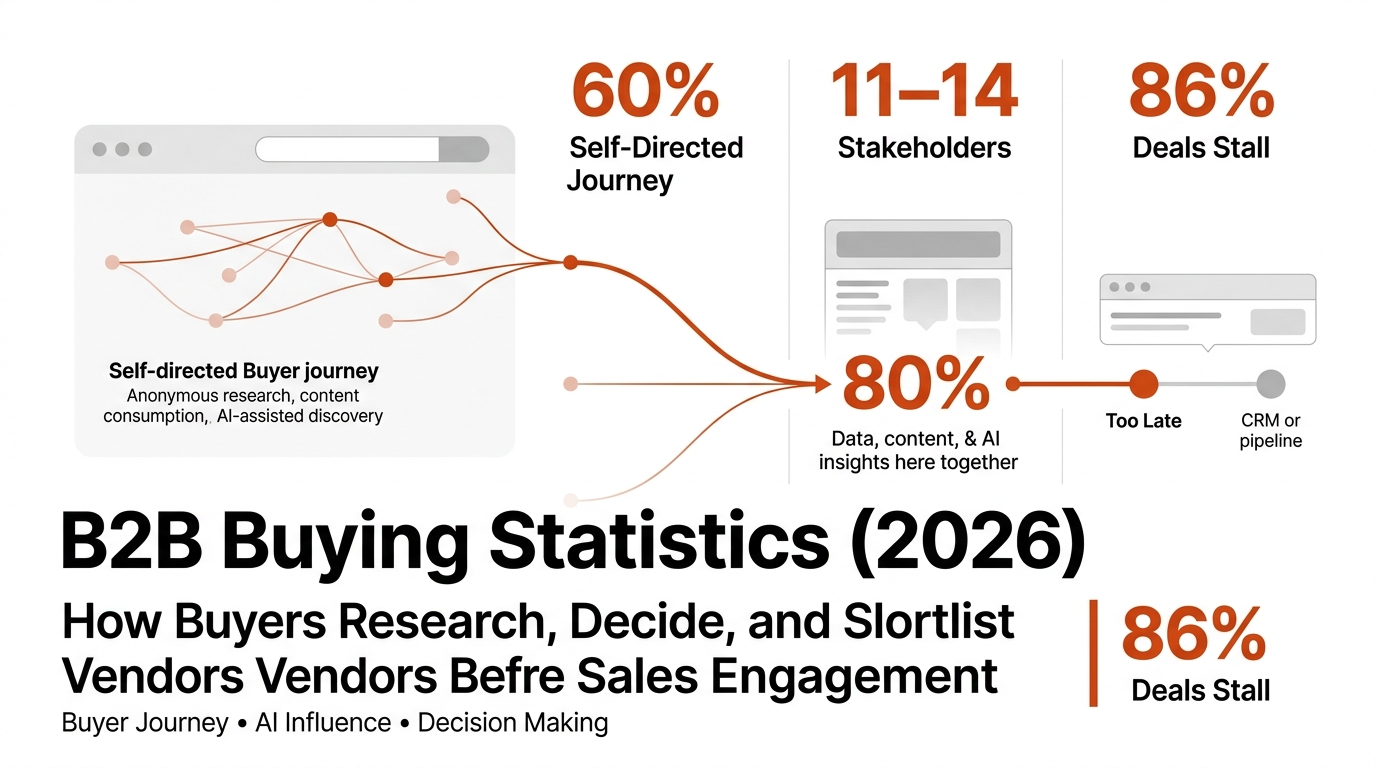
6sense’s 2026 research describes this as a two-phase process: Selection and Validation. Buyers spend approximately 60% of the journey in the Selection phase before engaging sellers.
This reinforces the importance of influencing buyers before they formally enter the sales process.
Why Is Early Visibility Important for B2B Software Companies?
When buyers conduct independent research, software companies have fewer opportunities to introduce themselves through direct sales interactions.
Brand visibility across digital research channels becomes increasingly important.
6sense’s 2026 research found that buyers’ preferred vendor before contacting sales ultimately won 82% of the time.
This does not mean that every early preference becomes a guaranteed purchase. However, it highlights how important initial consideration can be.
Here is why early visibility matters.
1. Buyers May Create Shortlists Before Contacting Vendors
If a software company is absent from the channels buyers use during early research, it may never be considered.
Businesses need to build visibility through search engines, industry publications, review platforms and professional communities.
2. Brand Familiarity Influences Product Consideration
Buyers may already recognise certain software brands through previous projects, industry discussions or professional recommendations.
Consistent visibility helps companies build familiarity before an active purchasing requirement emerges.
3. Educational Content Builds Trust
Buyers need reliable information to understand complex software products.
Content that explains technical concepts, implementation requirements and real business use cases can help establish credibility.
4. Product Transparency Reduces Evaluation Friction
Clear pricing, feature descriptions, integration details and security information help buyers assess product suitability independently.
When essential information is difficult to access, potential customers may move towards vendors that provide greater transparency.
How Software Companies Can Improve B2B Product Discovery
As the buying journey becomes more self-directed, software companies need to adapt their digital presence and content strategies.
The objective is to make product information accessible, useful and trustworthy across the channels buyers already use.
1. Build an SEO-Driven Content Strategy
Search engines remain important for discovering software products and understanding business challenges.
Companies should create content around relevant search queries at different stages of the buying journey.
For example:
| Buyer research stage | Example search query | Recommended content |
|---|---|---|
| Awareness | What is workflow automation? | Educational guides |
| Exploration | Benefits of workflow automation software | Informational articles |
| Comparison | Best workflow automation platforms | Comparison pages |
| Evaluation | Platform A vs Platform B | Detailed comparison articles |
| Decision | Workflow automation software pricing | Pricing and product pages |
This approach helps businesses reach buyers with different levels of product awareness and purchase intent.
2. Optimise Content for Answer Engine Optimisation (AEO)
Answer Engine Optimisation focuses on making content easy for search engines and AI-powered systems to understand and use when responding to questions.
Software companies can improve AEO by:
- Answering common questions directly
- Using descriptive headings
- Providing clear product explanations
- Including relevant technical details
- Supporting claims with credible sources
- Publishing structured FAQs
- Maintaining consistent product information
For example, a software company should provide a clear explanation of what its platform does, who it serves and which business problems it addresses.
This helps both human readers and AI systems interpret the content.
3. Strengthen Visibility Across AI Search and LLMs
As buyers use AI assistants for product research, software companies should consider how their products are represented across relevant digital sources.
Important activities include:
- Publishing detailed product documentation
- Creating useful comparison content
- Maintaining accurate company and product information
- Earning genuine third-party mentions
- Publishing original research and expert insights
- Building a consistent digital brand presence
LLM optimisation should focus on factual accuracy, clear context and credible information rather than attempting to manipulate AI-generated answers.
4. Build a Strong Presence on Software Review Platforms
Encourage satisfied customers to share honest feedback on relevant software review platforms.
Keep product descriptions, screenshots and feature information updated.
Respond professionally to both positive and negative reviews.
Authentic customer experiences can help potential buyers understand product strengths and limitations.
5. Make Product Information Accessible Without Mandatory Sales Contact
Not every buyer wants to schedule a demonstration to understand basic product capabilities.
Provide accessible information such as:
- Product feature pages
- Pricing details or pricing guidance
- Technical documentation
- Integration information
- Product videos
- Security documentation
- Implementation guides
This creates a more convenient research experience and allows sales representatives to focus on higher-value discussions.
6. Publish Original Research and Customer Case Studies
Original research and practical customer stories can differentiate a software company from competitors publishing similar generic content.
Case studies should explain:
- The customer’s business challenge
- Why the solution was selected
- How implementation was approached
- Which features were used
- What measurable outcomes were achieved
Use verified data and obtain customer approval before publishing specific results.
Original insights can also strengthen brand credibility and provide useful information for buyers researching software options.
7. Align Marketing and Sales Teams
Marketing and sales teams should work together to understand the questions buyers ask before contacting vendors.
Marketing can use these insights to develop relevant content, while sales teams can use them to prepare more meaningful conversations.
Rather than treating every content interaction as an immediate sales opportunity, businesses should focus on understanding buyer needs and providing relevant support at the right time.
Key Metrics to Measure B2B Product Discovery Performance
Traditional lead-generation metrics alone may not provide a complete picture of how buyers discover and evaluate software.
Businesses should monitor a broader set of indicators.
| Metric | What it measures | Why it matters |
|---|---|---|
| Organic search visibility | Performance across relevant search queries | Measures discoverability |
| Branded search volume | Searches for the company or product name | Indicates brand awareness |
| Review platform visibility | Presence and engagement on software review sites | Tracks third-party discovery |
| Product page engagement | Interaction with important product pages | Shows research interest |
| Demo engagement | Interaction with product demonstrations | Indicates product evaluation |
| Content-assisted conversions | Conversions influenced by content | Shows content contribution |
| Qualified pipeline | Opportunities that match target customer requirements | Connects discovery with revenue |
| AI referral traffic | Website visits from identifiable AI sources | Provides insight into AI-assisted discovery |
No single metric captures the entire buyer journey.
Businesses should combine search performance, brand visibility, content engagement and sales outcomes to understand how their product discovery strategy is performing.
The Future of B2B Product Discovery
B2B product discovery will continue to evolve as search technology, AI capabilities and buyer expectations change.
Several developments are likely to influence how businesses research software in the coming years.
1. AI-Powered Search Will Become More Integrated
AI-powered search experiences will make it easier for buyers to ask complex questions and receive summarised information.
Software companies will need to ensure that their product information is accurate, accessible and clearly structured across digital channels.
2. Buyers Will Expect Greater Product Transparency
Buyers increasingly want to understand product capabilities, pricing, security and implementation requirements before speaking with sales.
Companies that provide clear and accessible information can reduce unnecessary friction during evaluation.
3. Product-Led Experiences Will Support Independent Evaluation
Interactive product tours, free trials, sandbox environments and self-service demonstrations can help buyers experience software before committing to a sales conversation.
These experiences allow potential customers to assess usability and product fit through practical exploration.
4. Peer Recommendations Will Remain Important
Even as AI-powered research expands, professional networks and customer experiences will continue to influence B2B purchasing decisions.
Software companies should invest in customer success and encourage authentic advocacy.
5. Sales Engagement Will Become More Consultative
When buyers complete much of their initial research independently, sales representatives need to provide value beyond basic product explanations.
They can help buyers validate technical requirements, assess implementation risks, understand commercial options and build internal purchasing confidence.
The future of B2B sales is therefore closely connected to the quality of the digital research experience that comes before it.
Conclusion
B2B product discovery is moving towards a more independent, digital and research-driven model.
Buyers increasingly use search engines, software review platforms, comparison websites, professional communities and AI assistants to understand products before contacting sales representatives.
This shift means software companies must build visibility and credibility long before a potential customer requests a demonstration.
A strong product discovery strategy requires more than traditional lead generation. It involves creating useful content, maintaining accurate product information, strengthening third-party credibility and making product evaluation easier.
SEO, AEO and LLM optimisation can help software companies improve discoverability across traditional and AI-powered search environments.
At the same time, transparent product information, genuine customer reviews and accessible demonstrations help buyers make informed decisions.
Ultimately, the companies that understand how buyers research software will be better positioned to earn consideration, build trust and enter sales conversations with more informed prospects.
Frequently Asked Questions (FAQs)
1. What is B2B product discovery?
B2B product discovery is the process through which business buyers identify, research, compare and evaluate software products before making a purchasing decision. It includes search engine research, product comparisons, customer reviews and vendor evaluation.
2. How do B2B buyers research software before contacting sales?
B2B buyers typically use search engines, software review websites, comparison articles, professional communities, AI assistants and vendor websites. They may also watch product demonstrations and consult industry peers before shortlisting vendors.
3. Why is B2B product discovery important?
B2B product discovery is important because it influences which software companies buyers consider during the purchasing process. Strong visibility across relevant digital channels helps businesses build brand awareness, establish credibility and attract potential customers.
4. What role does AI play in B2B product discovery?
AI helps buyers research software by answering questions, summarising product information and comparing features. It can also support vendor evaluation and technical research. However, buyers should verify AI-generated information through reliable sources.
5. What is the role of SEO in B2B product discovery?
SEO helps software companies appear in search results when potential customers research business challenges, software categories and product comparisons. It improves organic visibility and helps businesses attract buyers at different stages of the purchasing journey.
6. How do software review platforms influence B2B buying decisions?
Software review platforms provide customer feedback, ratings and product comparisons. They help buyers evaluate usability, customer support, product functionality and implementation experiences before contacting vendors.
7. What is the difference between B2B product discovery and lead generation?
B2B product discovery focuses on helping buyers identify and evaluate potential solutions. Lead generation focuses on identifying and attracting potential customers who may be interested in purchasing. Product discovery often happens before a buyer becomes an identifiable sales lead.
8. What is the role of AEO in B2B product discovery?
Answer Engine Optimisation helps make software content easier for search engines and AI-powered systems to understand and use when answering relevant questions. Clear explanations, structured headings and credible information can improve content accessibility across answer-based search experiences.
9. How can B2B software companies improve product discovery?
Software companies can improve product discovery through SEO, useful educational content, software review platforms, AI search optimisation, transparent product information, product demonstrations and customer case studies.
10. Why do B2B buyers prefer self-service software research?
Self-service research allows buyers to explore product features, compare vendors and understand pricing at their own pace. It also helps buying groups gather information and align internally before speaking with sales representatives.
11. What is the role of product demonstrations in B2B software discovery?
Product demonstrations help buyers understand how software works in practical business environments. Videos, interactive tours and free trials allow potential customers to assess usability and functionality before requesting a sales consultation.