
A sales deal can move through discovery, product demonstrations, pricing discussions, and contract negotiations without a major problem—only to grind to a halt when the buyer sends a security questionnaire.
For many SaaS and B2B companies, this has become an increasingly familiar scenario. The prospect is interested. The business case is clear. The champion is ready to move forward. Then procurement or the security team sends a spreadsheet containing hundreds of questions about encryption, access controls, data retention, incident response, business continuity, employee security, compliance, and third-party vendors.
Suddenly, the sales team is waiting on security, engineering, IT, legal, or compliance to provide answers.
The problem is not that security questionnaires exist. Enterprise buyers have legitimate reasons to assess the security and operational risks associated with their vendors. Third-party risk has become a significant concern, and organizations need documented processes for evaluating suppliers.
The problem is that the questionnaire process has become a bottleneck between a vendor being commercially approved and actually getting the contract signed.
Recent industry discussions show the same pattern repeatedly: questionnaires are becoming more detailed, buyers are sending them earlier or more frequently, and vendors are often still handling them through spreadsheets, email threads, shared folders, and manual internal follow-ups.
For companies selling into enterprise accounts, that creates a revenue problem.
What Is a Security Questionnaire?
A security questionnaire is a structured assessment that a prospective customer sends to a vendor to understand how that vendor protects systems, information, employees, and customer data.
Questions can cover areas such as:
- Access management
- Data encryption
- Identity and authentication
- Vulnerability management
- Penetration testing
- Incident response
- Business continuity and disaster recovery
- Employee security training
- Data privacy
- Subprocessors and third-party vendors
- Physical security
- Security monitoring
- Secure software development
- Compliance certifications
- Data retention and deletion
Some questionnaires are relatively short. Others can contain hundreds of questions. They may arrive as Excel spreadsheets, Word documents, PDFs, online forms, or through specialized vendor-risk portals.
Frameworks and standardized assessments can make the process more consistent, but many enterprise buyers also use customized questionnaires designed around their specific risks.
From the buyer’s perspective, this makes sense. A large organization may depend on hundreds or thousands of vendors and cannot conduct a full security audit of every supplier. A questionnaire provides a scalable way to collect information and determine whether additional review is necessary.
For the vendor, however, the questionnaire can become a major operational burden.
And when that burden sits directly in the path of revenue, it becomes a sales problem.
Why Security Questionnaires Are Becoming More Important
Security questionnaires have existed for years. What has changed is their importance in the buying process.
Enterprise organizations are increasingly concerned about supply-chain risk, regulatory obligations, data protection, and the security practices of their vendors. Security reviews are therefore no longer something that happens quietly in the background after a purchasing decision.
They can become a formal gate before a deal is approved.
In many enterprise sales processes, a vendor can successfully complete the product evaluation and commercial negotiation but still be unable to reach signature until the security team approves the supplier.
That changes the role of the questionnaire.
It is no longer simply an information-gathering exercise.
It is part of the sales funnel.
Industry coverage in 2026 increasingly describes security reviews as a recurring source of enterprise sales friction, with vendors reporting that questionnaires can add days or weeks to deals when responses depend on manual coordination.
The result is a strange situation: sales teams can generate demand faster than their organizations can complete the security work required to convert that demand into revenue.
The Real Sales Bottleneck Isn’t the Questionnaire
At first glance, it may seem that the number of questions is the problem.
A 300-question questionnaire certainly sounds painful.
But the number of questions is often not the biggest issue.
The real bottleneck is what happens behind each question.
Consider a question such as:
“Do you encrypt customer data at rest?”
It sounds simple.
But answering it accurately might require someone to confirm:
- Which systems store customer data
- Which databases are included
- What encryption technology is used
- Whether backups are encrypted
- Whether there are exceptions
- Whether the answer matches the company’s security policies
- Whether supporting evidence is available
- Whether the organization gave a different answer to another customer previously
Now multiply that process across hundreds of questions.
The questionnaire becomes a coordination exercise.
The sales representative may own the customer relationship, but they usually cannot answer technical security questions themselves. The security team has the expertise, but may not own the deal. Engineering knows how systems are configured, but has product deadlines. Legal may need to review privacy-related answers. Compliance may maintain certifications and policies.
Every handoff creates potential delay.
1. Security Teams Are Not Sales Teams
One of the biggest reasons questionnaires become a sales bottleneck is that the people responsible for answering them often have completely different priorities.
A salesperson wants the questionnaire completed quickly because the customer is waiting.
A security leader wants every answer to be accurate and defensible.
An engineer wants to keep shipping product.
A legal team wants to avoid making commitments that could create contractual exposure.
All of these priorities are reasonable.
But without a defined workflow, the questionnaire becomes a tug-of-war.
The salesperson sends a message:
“Can you answer these questions today?”
Security responds:
“We need engineering to confirm a few of these.”
Engineering responds:
“Can you tell us which customer this is for and when the deal closes?”
Meanwhile, the buyer is waiting.
The delay may have nothing to do with the company’s actual security posture. The organization may have excellent controls.
It simply lacks an efficient way to communicate those controls.
2. Every Questionnaire Repeats Work
Another major problem is repetition.
A company may answer essentially the same question dozens of times for different prospects.
One customer asks about encryption.
Another asks about encryption using slightly different wording.
A third asks for a description of encryption practices and supporting evidence.
A fourth asks the question through an online portal.
The underlying answer may be identical, but the team treats every questionnaire as a new project.
This creates unnecessary operational costs.
It also introduces inconsistency.
If the answer given in January differs from the answer given in April, the customer may ask why.
Sometimes the difference is legitimate. Perhaps the company changed a technology or updated its process.
But sometimes the discrepancy exists because different employees answered the questions differently.
That creates another round of questions—and another delay.
3. Security Questionnaires Arrive Late in the Sales Cycle
Timing makes the problem worse.
In many sales processes, security requirements are not fully understood until a deal is already well advanced.
The prospect has completed product evaluations. Stakeholders are aligned. Pricing has been discussed.
Then the security questionnaire arrives.
This is particularly painful because the vendor has already invested significant sales and marketing resources in the opportunity.
If the questionnaire takes two weeks to complete, the entire deal can effectively pause for two weeks.
And sales momentum matters.
A buyer who was enthusiastic on Monday may have different priorities by the end of the month. Budget windows can close. Internal champions can leave. Competing projects can appear.
A security review does not merely consume time.
It consumes momentum.
4. The Sales Team Becomes the Project Manager
When there is no dedicated questionnaire workflow, sales representatives often become the middlemen.
They receive the questionnaire from the customer.
Then they forward it internally.
Then they chase the security team.
Then they answer the buyer’s follow-up questions.
Then they request evidence.
Then they discover that one answer needs legal approval.
Then they go back to the customer.
This is not selling.
Yet it can consume a significant amount of a salesperson’s time.
Instead of focusing on discovery, stakeholder alignment, objection handling, negotiation, and closing, the account executive becomes a project manager for an internal security assessment.
The larger the organization becomes, the worse this can get.
A company closing one enterprise deal per quarter might handle the process manually.
A company pursuing dozens of enterprise opportunities cannot scale that way.
5. Security Questionnaires Can Expose Documentation Gaps
Questionnaires do something else that can create sales friction: they reveal whether a company’s security practices are actually documented.
A company may have good security controls but poor documentation.
For example, the organization may use strong access controls, but nobody has clearly documented the process.
It may have an incident response plan, but the latest version is difficult to locate.
It may conduct security training, but the evidence is stored across multiple systems.
It may have a vendor management process, but ownership is unclear.
When the questionnaire arrives, the company suddenly has to prove what it does.
This distinction is important.
Having security controls is not the same as being able to demonstrate those controls efficiently.
Enterprise buyers increasingly want evidence, not just assurances. Documentation, certifications, policies, reports, and other artifacts can be important components of the review process.
That means sales readiness increasingly depends on security readiness.
6. Inconsistent Answers Create More Questions
Speed is important, but accuracy is even more important.
A rushed questionnaire can create a different problem if employees provide inconsistent or overly broad answers.
Imagine that one questionnaire says customer data is deleted within 30 days.
Another says it is deleted within 60 days.
A third says data is retained according to contractual requirements.
The buyer may ask for clarification.
Now the security team has to investigate the discrepancy.
The salesperson has to explain it.
The buyer may escalate the issue to its security or legal team.
What began as a simple questionnaire response can turn into a significant review.
This is why the goal should not be simply to “answer questionnaires faster.”
The goal should be to answer them faster without sacrificing accuracy or consistency.
7. Manual Processes Don’t Scale With Enterprise Growth
Manual processes can work when questionnaire volume is low.
They become increasingly expensive as a company grows.
Imagine a company receives five questionnaires per month.
Each one requires several hours of internal work.
That may be manageable.
Now imagine the company is pursuing an aggressive enterprise sales strategy and receives 30 or 40 questionnaires every month.
The same workflow suddenly consumes hundreds of hours.
The problem is compounded because questionnaires are rarely completed by one person.
A single assessment may involve security, engineering, legal, compliance, IT, privacy, and sales.
The organization therefore isn’t just spending time filling in cells.
It is spending time coordinating people.
That coordination cost is easy to overlook because it does not appear as a line item on the questionnaire.
But it directly affects sales capacity.
The Hidden Cost: Delayed Revenue
The most important consequence of a security questionnaire bottleneck is not employee frustration.
It is delayed revenue.
Suppose an enterprise deal is worth $100,000 in annual recurring revenue.
The product is approved.
The buyer is ready.
The commercial terms are acceptable.
But the security review takes another three weeks.
The company has effectively pushed the revenue event further into the future.
Multiply that across several opportunities and the impact becomes significant.
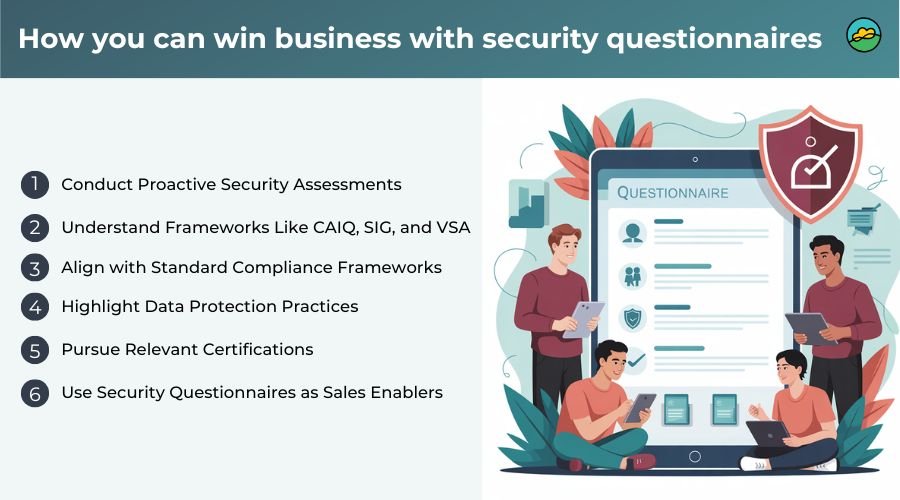
This is why security questionnaire management should not be viewed solely as a compliance task.
It is part of revenue operations.
The faster a qualified opportunity can move through security review, the faster it can move toward signature.
What Companies Can Do About the Bottleneck
The good news is that organizations do not necessarily need to eliminate security questionnaires.
They need to make the process repeatable.
Build a Central Answer Library
The first step is to create a centralized collection of approved answers.
Instead of answering every question from scratch, teams should maintain reusable responses for recurring topics.
The library might include approved answers covering:
- Encryption
- Authentication
- Access control
- Incident response
- Vulnerability management
- Disaster recovery
- Data retention
- Privacy
- Employee training
- Subprocessors
- Business continuity
- Secure development
Each answer should have an owner and, where appropriate, supporting evidence.
The objective is to turn security knowledge into organizational knowledge rather than keeping it inside individual employees’ heads.
Connect Answers to Evidence
An answer library is useful, but evidence makes it stronger.
Where appropriate, answers should connect to relevant documentation such as certifications, policies, reports, diagrams, or other approved evidence.
This helps security teams avoid searching through multiple systems every time a buyer asks a question.
It also makes reviews more defensible.
Establish Clear Ownership
Every questionnaire should have an owner.
That does not mean one person needs to answer every question.
It means one person is accountable for coordinating the process.
A simple responsibility model can define who handles:
- Security questions
- Privacy questions
- Legal questions
- Technical architecture questions
- Compliance evidence
- Customer communication
Without clear ownership, questionnaires tend to become everyone’s responsibility—and therefore nobody’s responsibility.
Start Earlier in the Sales Process
One of the best ways to reduce questionnaire-related surprises is to identify security requirements earlier.
Sales teams can ask prospects questions such as:
- Does your procurement process require a security assessment?
- Do you have a standard questionnaire?
- Which certifications are required?
- Is security approval required before contract signature?
- Are there specific evidence requirements?
- Are there deadlines associated with the review?
These questions help sales teams understand the potential timeline before the opportunity reaches the final stage.
Security requirements should be treated as part of qualification, not as a surprise at the finish line.
Standardize the Workflow
A repeatable workflow can turn an unpredictable process into a predictable one.
For example:
Questionnaire received → Scope assessed → Owner assigned → Questions categorized → Approved answers reused → Experts handle exceptions → Evidence attached → Final review → Customer submission
The exact workflow will vary by organization.
What matters is that it exists.
Automation Is Becoming Part of the Solution
As questionnaire volumes grow, automation is increasingly attractive.
Modern tools can help organizations identify similar questions, reuse approved responses, organize evidence, and reduce repetitive manual work. Some solutions can also work across common questionnaire formats and workflows.
However, automation should not mean blindly generating answers.
Security questionnaires are too important for that.
The ideal model combines automation with human oversight.
Automation can help with repetitive work:
- Finding similar historical questions
- Suggesting approved answers
- Identifying missing information
- Locating evidence
- Tracking questionnaire status
- Detecting potentially inconsistent responses
- Routing questions to the appropriate subject-matter expert
Humans should remain responsible for sensitive decisions, exceptions, ambiguous questions, and final approval.
The objective is not to remove security professionals from the process.
It is to stop them from spending their time answering the same question for the hundredth time.
Turn Security Readiness Into a Sales Advantage
There is another way to think about this problem.
Security questionnaires are often treated as an obstacle.
They can also become a competitive advantage.
Imagine two vendors competing for the same enterprise customer.
Vendor A takes three weeks to return the security questionnaire.
Vendor B returns a complete, consistent, evidence-backed response in a few days.
The second vendor has created less friction for the buyer.
That matters.
Enterprise buyers are not only evaluating product functionality. They are also evaluating whether a vendor appears organized, trustworthy, and capable of meeting enterprise requirements.
A fast and professional security review can reinforce those perceptions.
In other words, security readiness can become part of the customer experience.
The Future of Enterprise Sales Is More Security-Driven
The security questionnaire is unlikely to disappear.
If anything, the trend is moving in the opposite direction.
Enterprise buyers have more vendors to evaluate, more data to protect, more regulatory obligations to consider, and greater pressure to understand third-party risk.
That means security assessments will remain an important part of procurement.
The companies that struggle will be those that continue treating every questionnaire as a one-off administrative task.
The companies that perform well will build security questionnaire readiness into their operating model.
They will know their answers.
They will know their evidence.
They will know who owns each area.
They will identify security requirements early.
And they will use technology to reduce repetitive work.
From Bottleneck to Business Process
Security questionnaires are becoming a sales bottleneck because they sit at the intersection of two increasingly important functions: enterprise sales and security.
Sales wants speed.
Security wants accuracy.
Procurement wants assurance.
Legal wants clarity.
The solution is not to choose one priority over another.
It is to build a process that supports all four.
A mature security questionnaire process should make it easy for sales teams to understand requirements, easy for security teams to provide accurate answers, and easy for buyers to verify the information they need.
When that happens, the questionnaire stops being a late-stage fire drill.
It becomes a predictable part of the sales process.
And that shift can have a meaningful impact on deal velocity.
The companies that recognize this early will have an advantage: they won’t just have strong security programs—they’ll be able to communicate those programs quickly and consistently when revenue is on the line.
Security questionnaires aren’t merely paperwork anymore. They’re part of the path to revenue.
The question for growing companies is no longer whether they will receive them.
It is whether they are prepared to respond before those questionnaires become the reason a deal stalls.