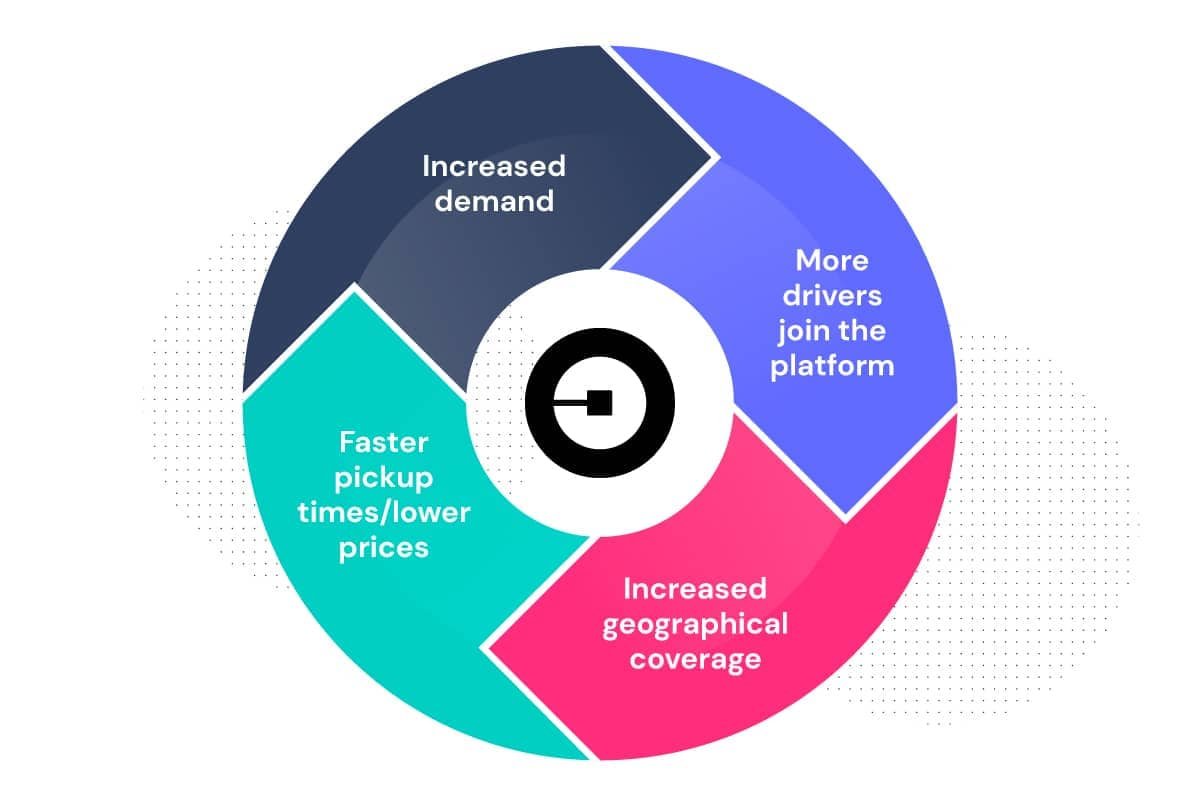
Introduction: The Funnel Is Breaking Under Pressure
If you’re leading growth or marketing in a B2B tech company, you’ve probably felt it.
You invest in campaigns, generate leads, push them through nurture flows, hand them to sales, and hope conversion rates hold up. But over time, something starts to crack:
- Customer acquisition costs keep rising
- Conversion rates plateau
- Pipeline becomes harder to predict
- Growth feels linear, not scalable
The traditional funnel model is not designed for how modern B2B buying actually works. Buyers are not moving in a straight line. They loop back, research independently, involve multiple stakeholders, and rely heavily on peer validation.
This is where B2B Growth Loops come in.
In this article, you’ll learn how growth loops work, why they outperform funnels, and how to implement them in a practical way inside your business. More importantly, you’ll see how to build systems that compound over time instead of resetting every quarter.
What Are B2B Growth Loops?
At a simple level, B2B Growth Loops are systems where your outputs become inputs for future growth.
Instead of a linear path like:
Traffic → Leads → Opportunities → Customers
You create a cycle like:
Customers → Value → Advocacy → New Customers → More Value
Each cycle feeds the next.
The Key Difference Between Funnels and Loops
Funnels are extractive. You put resources in, you get results out, then you start again.
Loops are compounding. Every action strengthens the system over time.
Here’s a practical way to think about it:
- Funnels answer: How do we convert?
- Growth loops answer: How do we grow continuously?
Why Traditional Funnels Fall Short in B2B
Before jumping into solutions, it’s important to understand the limitation.
1. B2B Buying Is Not Linear
A typical B2B deal involves:
- 6 to 10 stakeholders
- Multiple touchpoints
- Long decision cycles
Buyers revisit content, compare options, and seek validation repeatedly. A funnel cannot capture this complexity.
2. Acquisition Is Getting More Expensive
Paid channels are saturated. Organic reach is declining. Outbound is noisier than ever.
If your growth depends only on acquiring new leads, costs will keep rising.
3. Most Funnels Ignore Post-Sale Growth
Traditional models focus heavily on acquisition and conversion, but neglect:
- Customer expansion
- Referrals
- Advocacy
- Product-led growth
This leaves a massive growth lever unused.
The Core Idea Behind B2B Growth Loops
The goal is to design systems where growth is self-reinforcing.
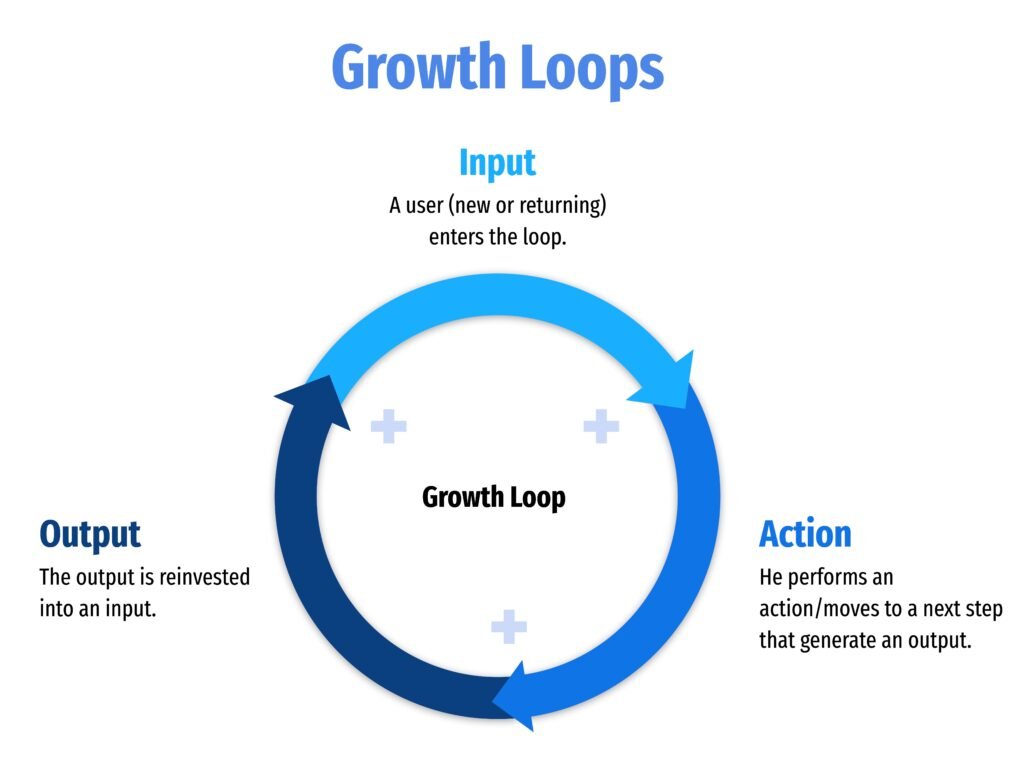
A strong loop has three parts:
- Input: A user action or resource
- Action: A process that creates value
- Output: A result that feeds back into the system
Simple Example
Let’s say you run a SaaS platform:
- Input: A new customer signs up
- Action: They use your product and see results
- Output: They share a case study or refer others
That output becomes the next input.
Types of B2B Growth Loops That Actually Work
Let’s move from theory to practice.
1. Content-Driven Growth Loops
This is one of the most accessible and effective loops for B2B companies.
How It Works
- Create high-value content
- Attract relevant audience
- Convert visitors into users or leads
- Capture insights from users
- Use those insights to create better content
Why It Compounds
Every piece of content:
- Improves SEO visibility
- Builds brand authority
- Attracts more qualified traffic
Mini Case Example
A B2B SaaS company publishes detailed guides based on real customer use cases.
Over time:
- Content ranks higher
- Sales conversations improve because prospects are educated
- New content becomes more targeted
The loop strengthens itself.
2. Product-Led Growth Loops
Here, your product becomes the growth engine.
How It Works
- Users experience value quickly
- They invite team members
- Teams expand usage
- More users bring more visibility
Example
Collaboration tools are classic examples. One user invites others, and adoption spreads across the organization.
Actionable Strategy
Focus on:
- Fast time to value
- Easy sharing or collaboration features
- Clear in-product prompts for expansion
3. Sales Feedback Loops
Your sales team is sitting on a goldmine of insights. Most companies underuse it.
How It Works
- Sales conversations generate insights
- Insights inform marketing and product
- Improved messaging and product increase conversions
- Better conversions generate more conversations
What to Capture
- Common objections
- Competitor comparisons
- Customer priorities
- Decision triggers
Mini Case Example
A company notices repeated objections around pricing.
Instead of lowering prices, they:
- Refine value messaging
- Introduce ROI calculators
- Train sales teams on value articulation
Conversion rates improve without changing pricing.
4. Customer Advocacy Loops
Happy customers are your most credible growth channel.
How It Works
- Customers achieve success
- They share testimonials or case studies
- These assets influence new buyers
- New buyers become customers
Why It Works in B2B
Trust matters more than ever. Buyers rely on:
- Peer validation
- Real-world results
- Social proof
Actionable Strategy
Make advocacy easy:
- Ask at the right moment
- Provide templates for testimonials
- Highlight customers publicly
5. Data Network Effects Loops
This is more advanced but extremely powerful.
How It Works
- More users generate more data
- More data improves your product
- Better product attracts more users
Example
Analytics platforms improve as they collect more usage data.
Key Insight
Not every company can build this, but if you can, it creates a strong competitive advantage.
A Practical Framework to Build B2B Growth Loops
If you’re starting from scratch, use this step-by-step approach.
Step 1: Identify Existing Growth Triggers
Look for actions that already drive growth:
- Customer referrals
- Content sharing
- Product invitations
- Repeat usage
You likely already have loops forming. They are just not structured.
Step 2: Map the Loop
Define:
- What starts the loop
- What creates value
- What feeds the next cycle
Keep it simple. If it’s too complex, it won’t scale.
Step 3: Reduce Friction
Ask:
- Where do users drop off?
- What slows down the loop?
- What prevents repetition?
Fix these points first.
Step 4: Accelerate the Loop
Increase:
- Speed
- Frequency
- Volume
Examples:
- Faster onboarding
- More content output
- Easier sharing mechanisms
Step 5: Measure What Matters
Track loop-specific metrics:
- Cycle time
- Output per input
- Conversion between stages
- Retention and expansion rates
Avoid vanity metrics.
Common Mistakes Companies Make
Even with the right intent, many companies struggle to implement B2B Growth Loops.
1. Treating Loops as Campaigns
Loops are systems, not one-time efforts.
If you stop investing, the loop weakens.
2. Overcomplicating the Model
Some teams try to design perfect loops with too many variables.
Start simple. Optimize over time.
3. Ignoring the Product
Marketing cannot compensate for a weak product experience.
If users don’t see value, the loop breaks.
4. Lack of Cross-Team Alignment
Growth loops require collaboration between:
- Marketing
- Sales
- Product
Silos will kill momentum.
A Contrarian Take: Funnels Are Not Dead, But They Are Not Enough
It’s easy to say funnels are obsolete. That’s not accurate.
Funnels still matter for:
- Conversion optimization
- Pipeline visibility
- Forecasting
But they should not be your primary growth model.
Think of it this way:
- Funnels convert demand
- Growth loops create demand
The real advantage comes when you combine both.
Practical Checklist: Are You Ready for B2B Growth Loops?
Use this to evaluate your current setup:
- Do you have at least one repeatable growth loop?
- Are customers contributing to growth in any way?
- Is your product helping drive acquisition or expansion?
- Are insights from sales feeding back into marketing?
- Are you measuring compounding effects over time?
If most answers are no, you are still operating in a funnel-only mindset.
Quick Example: Putting It All Together
Let’s say you run a B2B SaaS platform.
You can combine multiple loops:
Content Loop
- Publish insights from customer data
- Attract relevant audience
Product Loop
- Convert users through free trials
- Encourage team adoption
Advocacy Loop
- Turn successful users into case studies
- Use them to drive new acquisition
Each loop reinforces the others.
That’s when growth starts to feel less forced and more natural.
The Future of B2B Growth
B2B Growth Loops are not just a trend. They reflect how modern businesses scale.
As markets become more competitive:
- Efficiency will matter more than volume
- Trust will matter more than reach
- Experience will matter more than messaging
Companies that build strong loops will:
- Lower acquisition costs
- Improve retention
- Scale more predictably
Those relying only on funnels will struggle to keep up.
Conclusion: Build Systems, Not Campaigns
The biggest shift is not tactical. It’s strategic.
Stop thinking in terms of campaigns that start and end.
Start thinking in terms of systems that grow stronger over time.
B2B Growth Loops give you a way to:
- Turn customers into growth drivers
- Make your product part of acquisition
- Create compounding momentum
You don’t need to rebuild everything overnight.
Start with one loop. Test it. Improve it. Then layer in others.
Because in the long run, the companies that win are not the ones that spend the most.
They are the ones that build growth engines that keep running.