B2B service agreements are changing rapidly. As businesses become more dependent on cloud platforms, managed services, IT infrastructure, logistics providers, cybersecurity firms, and other outsourced partners, expectations around service quality have become much more precise. Companies no longer want vague promises about reliability or responsiveness. They want measurable commitments, transparent performance data, and meaningful consequences when those commitments are missed.
This is where SLA penalties are becoming increasingly important.
Service Level Agreements, commonly known as SLAs, have existed for decades. Traditionally, an SLA established expectations for uptime, response times, resolution times, availability, support, and other service metrics. However, many agreements treated these commitments as operational guidelines rather than commercially enforceable obligations.
That approach is changing.
Today, customers are demanding stronger accountability from their B2B service providers. If a provider fails to meet agreed service levels, customers increasingly expect some form of compensation, service credit, fee reduction, or other remedy. As a result, SLA penalties are moving from being a secondary contractual detail to becoming a major part of commercial negotiations.
This shift is reshaping how B2B agreements are negotiated, priced, monitored, and managed.
What Are SLA Penalties?
SLA penalties are contractual consequences that apply when a service provider fails to meet predefined service-level commitments.
An SLA may specify requirements such as:
- 99.9% monthly uptime
- A 30-minute incident response time
- Four-hour resolution for critical issues
- 95% on-time delivery
- Defined customer support response times
- Maximum acceptable system downtime
- Specific data recovery or restoration targets
- Security incident notification deadlines
When a provider fails to meet one of these obligations, the contract may trigger a penalty or other financial remedy.
The term “penalty” can cover several different mechanisms. A customer might receive a service credit, percentage reduction in its monthly invoice, refund, fee adjustment, or predetermined payment. In some agreements, repeated or serious failures may also give the customer the right to terminate the contract.
For example, imagine a company pays $50,000 per month for a managed technology service with a 99.9% uptime commitment. If the provider fails to meet that target, the agreement might provide a 5% service credit for that billing period.
The exact structure varies significantly between industries and contracts. What matters is that performance is connected to a defined commercial consequence.
Why SLA Penalties Are Becoming More Common
Several major changes in the B2B environment are driving the increased use of SLA penalties.
1. Businesses Depend More Heavily on External Providers
Modern organizations outsource a significant portion of their technology and operational infrastructure.
Cloud hosting, software platforms, payment processing, logistics, customer support, cybersecurity, data management, telecommunications, and other critical functions may all depend on external vendors.
When an external provider fails, the impact can extend far beyond an inconvenience.
A service outage can prevent employees from working, delay customer transactions, interrupt production, create regulatory problems, and damage a company’s reputation.
As dependency increases, buyers have stronger incentives to ensure vendors are accountable for service performance.
2. Service Performance Is Easier to Measure
Another major factor is the availability of data.
Modern monitoring platforms can track uptime, response times, ticket resolution, delivery performance, system availability, and other metrics continuously.
This makes it easier to determine whether a provider has met its contractual obligations.
Instead of debating whether a service was “good enough,” both parties can review measurable performance data.
That transparency makes SLA penalties easier to administer.
3. Customers Want Predictable Business Outcomes
B2B buyers increasingly expect vendors to contribute to predictable business results.
A company purchasing a managed service does not simply want access to software or infrastructure. It expects the service to remain available and functional at an agreed level.
Consequently, performance commitments are becoming more closely connected to commercial terms.
SLA penalties provide a mechanism for transferring some of the financial consequences of poor performance back to the provider.
How SLA Penalties Are Changing Contract Negotiations
SLA penalties are affecting negotiations before a contract is even signed.
Historically, negotiations might have focused heavily on pricing, contract duration, scope, and termination provisions. Today, service-level metrics can receive similar attention.
Buyers are asking questions such as:
- What happens if uptime falls below the agreed threshold?
- How quickly must critical incidents receive a response?
- How is downtime calculated?
- Which outages are excluded?
- What evidence determines whether an SLA was breached?
- Is there a cap on service credits?
- What happens after repeated failures?
- Can chronic underperformance trigger termination?
These questions demonstrate an important shift.
The SLA is no longer simply an operational appendix. It is becoming an important part of the commercial relationship.
The Difference Between Service Credits and Traditional Penalties
One of the most important developments in B2B contracting is the growing use of service credits.
A service credit typically reduces the customer’s future invoice when a provider misses an SLA target.
For example, a contract might provide:
- 2% credit for a minor SLA failure
- 5% credit for a more significant failure
- 10% credit for severe or repeated performance issues
This structure is often more practical than demanding direct cash damages for every service-level failure.
Service credits can also encourage both parties to maintain the commercial relationship. Instead of immediately escalating a dispute, the customer receives a predetermined remedy.
However, service credits must be carefully designed. If the maximum credit is extremely small compared with the customer’s losses, the remedy may have little practical value.
SLA Penalties Are Becoming More Sophisticated
Not all service failures have the same business impact.
A five-minute outage during a low-traffic period may be relatively harmless. The same five-minute outage during a critical transaction window could cause substantial damage.
As a result, modern SLA structures are becoming more sophisticated.
Instead of applying a single penalty to every failure, agreements may use tiered models.
For example:
| Performance Level | Potential Remedy |
|---|---|
| Meets SLA | No adjustment |
| Slightly below target | Small service credit |
| Materially below target | Larger service credit |
| Severe failure | Significant credit or fee reduction |
| Repeated failure | Escalation and remediation |
| Chronic failure | Termination rights |
This approach creates a closer relationship between service performance and commercial consequences.
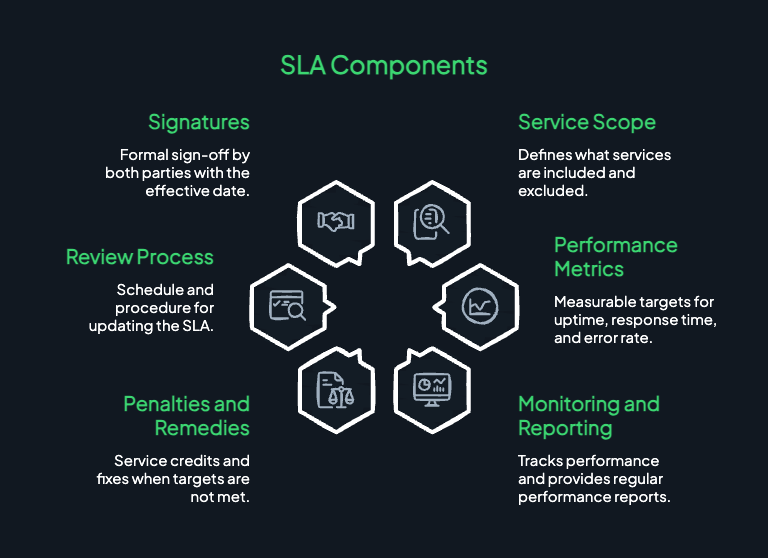
The Importance of Clearly Defined SLA Metrics
SLA penalties only work when the underlying SLA metrics are clearly defined.
Ambiguous metrics can create disputes.
Consider the phrase “99.9% availability.” At first glance, it appears straightforward. But several questions immediately arise.
Does planned maintenance count as downtime?
What about emergency maintenance?
Does a customer-side network problem count?
How are partial outages measured?
What happens if only one geographic region is affected?
What if the service is technically available but severely degraded?
These details matter.
A strong SLA should explain exactly how performance is measured and how a breach is calculated.
This includes defining:
- The measurement period
- The measurement methodology
- Data sources
- Exclusions
- Maintenance windows
- Incident classifications
- Business hours versus 24/7 coverage
- Calculation formulas
- Reporting responsibilities
Without these definitions, SLA penalties can become a source of conflict rather than accountability.
SLA Penalties and Vendor Pricing
SLA penalties can also influence pricing.
When a vendor accepts significant financial exposure for service failures, it may factor that risk into its pricing model.
For example, a provider offering aggressive SLA commitments may charge more than a provider offering less stringent commitments.
This creates an important commercial trade-off.
Customers may want maximum service guarantees, but stronger guarantees can increase vendor costs.
Providers may need additional infrastructure, staffing, redundancy, monitoring, backup systems, or operational processes to meet demanding service levels.
Therefore, SLA negotiations should not happen independently of pricing discussions.
The parties should consider whether the service price realistically supports the promised performance.
Risk Allocation Is at the Heart of SLA Penalties
At their core, SLA penalties are about risk allocation.
Every B2B service relationship contains operational risk.
The question is: who bears the financial consequences when something goes wrong?
Without SLA penalties, much of the risk may effectively remain with the customer.
With strong SLA remedies, some of that risk shifts toward the provider.
Neither approach is automatically correct.
The right structure depends on the service, the provider’s control over the relevant risks, and the potential impact of failure.
A provider should generally not be held financially responsible for circumstances it cannot reasonably control.
That is why well-drafted agreements often include exclusions for events such as customer-caused outages, unauthorized changes, force majeure events, third-party failures, or other specifically defined circumstances.
Avoiding Unrealistic SLA Commitments
One risk associated with stronger SLA penalties is overpromising.
A vendor may agree to an extremely aggressive SLA to win a contract, only to discover that the commitment is difficult or expensive to maintain.
This can create problems for both sides.
The provider faces repeated credits and escalating customer dissatisfaction. The customer experiences unreliable service despite having a strong contractual remedy.
The goal should therefore be realistic accountability rather than unrealistic guarantees.
Before accepting an SLA, both parties should assess historical performance and operational capability.
Questions should include:
- What performance level has the provider historically achieved?
- What infrastructure supports the commitment?
- How frequently have similar customers experienced incidents?
- What resources are available during major incidents?
- How quickly can capacity be added?
- What redundancy exists?
- How is disaster recovery handled?
An SLA should reflect what the provider can reliably deliver, not merely what sounds attractive during negotiations.
The Role of Automation in SLA Management
Technology is making SLA management increasingly automated.
Instead of relying on manual spreadsheets or periodic reports, companies can use monitoring systems to capture performance information continuously.
Automated systems can track whether:
- A system is available
- A support ticket was answered on time
- An incident exceeded its resolution target
- A delivery arrived within the agreed window
- A response-time threshold was exceeded
Automation can also trigger alerts and calculate potential service credits.
This reduces administrative work and creates a more objective record of performance.
For buyers, automated monitoring improves transparency.
For providers, it can reduce disputes by ensuring that both parties work from the same data.
SLA Penalties Are Also Changing Vendor Management
The impact of SLA penalties does not stop at the contract.
They are influencing ongoing vendor-management practices.
Procurement and vendor-management teams increasingly review SLA performance as part of regular supplier evaluations.
A vendor that repeatedly misses targets may face:
- Escalation meetings
- Corrective action plans
- Increased monitoring
- Commercial renegotiation
- Reduced scope
- Competitive rebidding
- Contract termination
This means SLA performance can influence a vendor’s long-term relationship with the customer.
A provider therefore has an incentive to treat SLA management as a strategic business function rather than merely a contractual obligation.
What Buyers Should Look for in SLA Penalties
Businesses negotiating B2B agreements should evaluate more than the headline penalty percentage.
Important considerations include the following.
The Size of the Remedy
A penalty should be meaningful enough to encourage compliance.
A tiny service credit may technically compensate the customer while providing little incentive for improvement.
The Trigger
The agreement should clearly state what constitutes a breach.
The Calculation
Both parties should understand how the penalty or credit is calculated.
The Cap
Many contracts place a maximum limit on credits or penalties. Buyers should assess whether that cap is reasonable relative to the potential business impact.
Repeated Failures
A single failure may be manageable. Repeated failures indicate a systemic problem.
Contracts should therefore address chronic underperformance.
Escalation Rights
Customers may need additional remedies when service levels deteriorate significantly.
Termination Rights
In critical outsourcing relationships, persistent SLA failures may justify termination or transition rights.
What Service Providers Should Consider
SLA penalties are not only a customer concern.
Providers should carefully evaluate their own exposure before signing an agreement.
They should make sure that:
- SLA metrics are measurable.
- Responsibilities are clearly divided.
- Exclusions are properly defined.
- Penalty calculations are understandable.
- Caps are commercially reasonable.
- Customer dependencies are documented.
- Performance reporting is transparent.
- Internal teams understand the commitments.
Providers should also avoid accepting obligations that depend on factors outside their control.
For example, if a vendor’s service depends on customer-provided infrastructure, the contract should clearly explain how customer-caused failures affect SLA calculations.
SLA Penalties and Customer Expectations
Another important consequence of stronger SLA structures is the change in customer expectations.
Once a customer sees a measurable commitment in a contract, it may expect that commitment to be consistently enforced.
This makes communication especially important.
Providers should not wait until a penalty is triggered before discussing performance problems.
Early communication can help preserve trust.
For example, if a provider knows that an incident may cause an SLA breach, proactively informing the customer can demonstrate accountability even when the commercial remedy still applies.
The financial credit may address the contractual consequence, but transparent communication addresses the relationship.
Are SLA Penalties Always Effective?
Not necessarily.
A penalty can compensate a customer without fixing the underlying problem.
If a provider repeatedly pays service credits but continues to underperform, the contract may be functioning financially while failing operationally.
This is why SLA penalties should be combined with improvement mechanisms.
These can include:
- Root-cause analysis
- Corrective action plans
- Performance reviews
- Incident-management procedures
- Service-improvement plans
- Executive escalation
- Technology upgrades
- Staffing changes
The best SLA structure does not simply punish failure. It creates incentives to prevent recurring failure.
The Shift Toward Outcome-Based Agreements
The next stage in B2B contracting may involve moving beyond traditional service metrics toward outcome-based agreements.
Traditional SLAs often focus on operational measurements such as uptime, response time, or resolution time.
Outcome-based agreements may focus more directly on business results.
For example, instead of simply measuring whether a system is available, a contract might consider transaction success rates or other business-critical outcomes.
This creates new opportunities but also new challenges.
Outcome metrics can be harder to measure and may involve factors outside a vendor’s control.
As a result, organizations will need to balance meaningful business outcomes with metrics that can be objectively attributed to the provider.
How SLA Penalties Can Improve B2B Relationships
Although the word “penalty” can sound adversarial, a well-designed SLA can actually strengthen a B2B relationship.
Clear expectations reduce ambiguity.
Transparent measurement reduces arguments.
Defined remedies reduce uncertainty.
Regular performance reviews encourage communication.
In this sense, SLA penalties can create a framework for accountability rather than simply punishment.
The key is proportionality.
A healthy agreement should make both parties understand what good performance looks like, what happens when performance falls short, and how problems will be addressed.
The Future of SLA Penalties
As B2B services become increasingly digital and interconnected, SLA penalties are likely to remain an important part of commercial agreements.
However, their structure will continue to evolve.
Future agreements may include more real-time performance monitoring, automated credit calculations, dynamic service thresholds, AI-assisted incident analysis, and more detailed performance reporting.
Contracts may also become more flexible.
Instead of using a single annual SLA framework, some businesses may adopt continuously monitored performance models that adjust requirements based on business conditions.
For example, a service might have different performance expectations during normal periods and critical business events.
This could make SLA structures more closely aligned with actual business risk.
Best Practices for Designing Effective SLA Penalties
Organizations can make SLA penalties more effective by following several principles.
Keep metrics measurable. Avoid vague language that can be interpreted differently by each party.
Make consequences proportional. Penalties should reflect the seriousness of the failure.
Define exclusions carefully. Providers should not be responsible for events outside their reasonable control.
Address repeated failures. Chronic underperformance requires stronger remedies than isolated incidents.
Connect penalties with improvement. Financial credits alone may not solve recurring problems.
Automate measurement where possible. Reliable data reduces disputes.
Review SLAs periodically. Business needs and technology change over time.
Align service levels with pricing. Aggressive commitments should be supported by appropriate commercial terms.
Clarify responsibility. Each party should understand which actions are required to maintain the agreed service level.
Consider termination and transition rights. For critical services, customers need a clear path forward if performance becomes consistently unacceptable.
Conclusion
SLA penalties are reshaping B2B service agreements by turning service performance into a more measurable and commercially accountable component of vendor relationships.
As businesses become increasingly dependent on external providers, service failures can have significant financial and operational consequences. This has created greater demand for contracts that clearly define performance expectations and establish meaningful remedies when those expectations are missed.
The most effective SLA penalties are not simply punitive. They create accountability, encourage transparency, allocate risk, and motivate providers to maintain reliable service.
For customers, the challenge is to negotiate remedies that are meaningful without creating unrealistic or unnecessarily adversarial relationships.
For service providers, the priority is to accept commitments that are measurable, achievable, and supported by the right operational capabilities.
Ultimately, the future of B2B service agreements will depend on a closer connection between contractual promises and measurable business performance. SLA penalties are an important part of that transformation.
As monitoring becomes more sophisticated and business dependency on external services continues to grow, organizations will increasingly expect their vendors to do more than promise good service. They will expect providers to prove performance—and take responsibility when performance falls short.