B2B companies spend millions on software with one simple expectation: people will use it to improve the business.
But buying software and getting value from software are two very different things.
A company can implement a powerful CRM and still have sales representatives updating it inconsistently. It can invest in an advanced analytics platform while employees continue relying on spreadsheets. It can deploy new collaboration software only to discover that teams barely use half its features.
The technology is available.
The problem is adoption.
This is becoming a bigger challenge as B2B organizations build increasingly complex software environments. Employees are expected to navigate CRMs, ERP systems, marketing platforms, project management tools, customer support software, analytics applications and countless other systems.
Every application has its own interface, workflow and learning curve.
Training can help, but traditional training has a limitation. People often forget what they learned when they return to their daily work.
This is where Digital Adoption Platforms (DAPs) are gaining attention.
Rather than asking employees to leave their workflow to learn software, DAPs provide contextual guidance directly inside applications. They can help users complete tasks, discover features, follow processes and get more value from the technology already available to them.
For B2B technology leaders, the opportunity is significant.
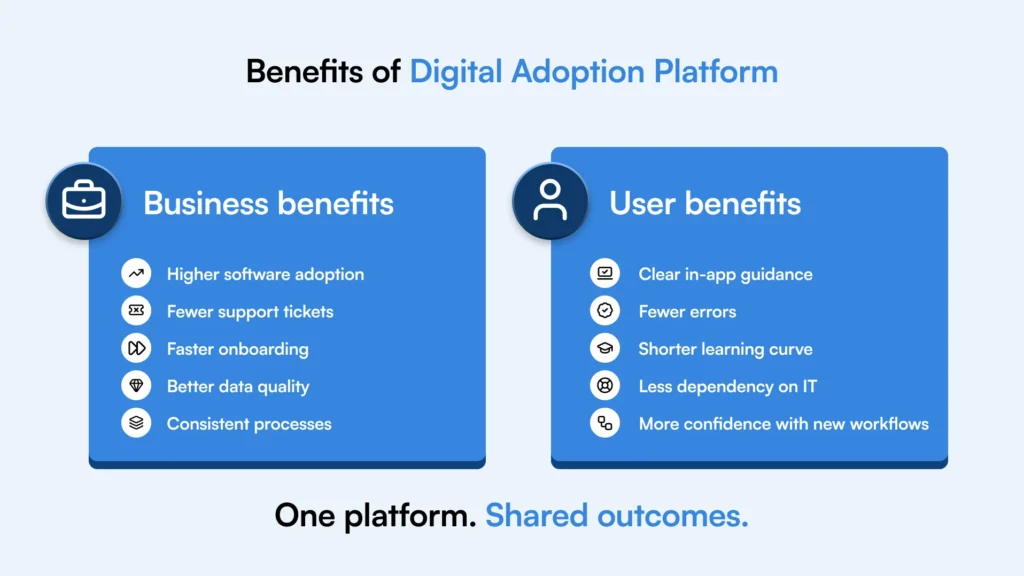
Better digital adoption can improve software utilization, employee productivity, onboarding, process consistency and return on technology investment.
But there is a bigger idea behind the trend.
The value of software is not determined by what a platform can do. It is determined by what people actually do with it.
What Is a Digital Adoption Platform?
A Digital Adoption Platform is a software layer that helps users understand and navigate digital applications.
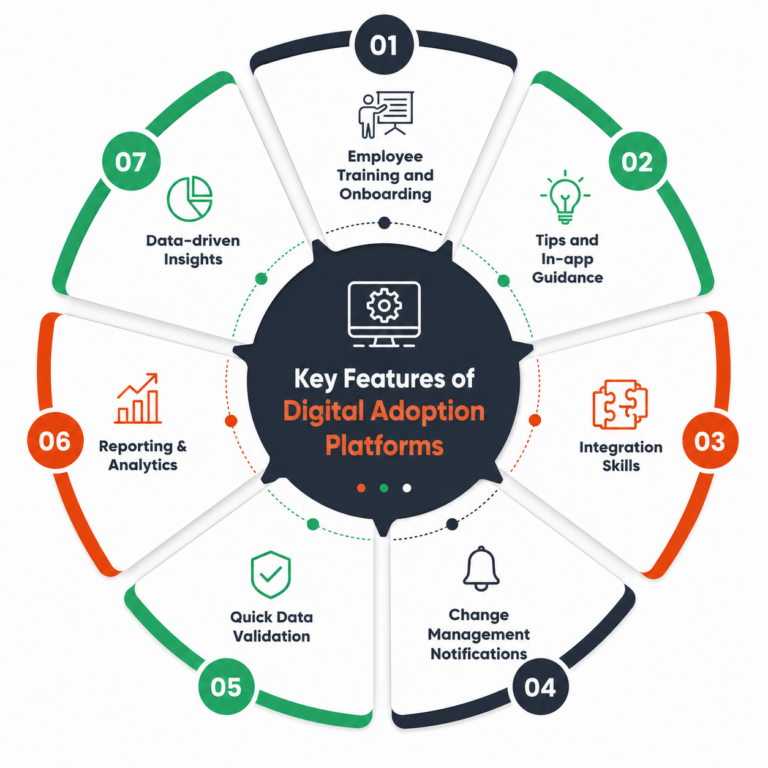
It can provide things such as:
- In-app guidance
- Interactive walkthroughs
- Contextual tips
- On-screen prompts
- Process guidance
- Feature discovery
- User onboarding
- Task assistance
- Usage analytics
The key difference is where the guidance appears.
Traditional training might involve a workshop, presentation or video.
A DAP provides guidance while the employee is using the software.
For example, imagine a sales representative opening a CRM for the first time.
Instead of sending them to a training portal, the platform can guide them through the specific steps needed to create an opportunity, update account information or complete a required field.
The learning happens within the workflow.
That makes digital adoption more immediate and practical.
Why Software Adoption Is a Business Problem
Software adoption is sometimes treated as an IT or training issue.
For B2B organizations, it is much more than that.
Poor adoption can affect revenue, productivity, data quality and customer experience.
Consider a CRM implementation.
The company invests in the software because leadership wants better visibility into the sales pipeline.
But if sales representatives do not consistently update opportunity stages, close dates or account information, the organization does not get the visibility it expected.
The problem is not necessarily the CRM.
The problem is the gap between the software’s capabilities and employee behavior.
This gap is where digital adoption becomes strategically important.
The Hidden Cost of Underused Software
Underused software creates a cost that is difficult to see on an invoice.
Suppose a company pays for an advanced marketing platform with dozens of automation features.
The marketing team uses email campaigns and basic segmentation but ignores lead scoring, workflow automation and behavioral triggers.
The company is technically using the platform.
It is not fully benefiting from the investment.
This happens frequently because software vendors continue adding capabilities while users have limited time to learn them.
The result is what could be called feature debt.
The company owns useful functionality that nobody has integrated into everyday workflows.
Feature availability is not feature adoption
This distinction is critical.
A software platform might offer:
- 100 features
- 50 workflows
- 20 automation options
- 10 reporting modules
That does not mean users will naturally discover or use them.
More features can sometimes make adoption harder.
Users tend to focus on the tasks they need to complete today.
If a feature is difficult to discover or understand, it may never become part of the workflow.
Digital Adoption Platforms can reduce that friction by surfacing relevant functionality at the moment it is needed.
Digital Adoption Platforms and Employee Productivity
Productivity is one of the strongest business cases for digital adoption.
Employees lose time when they:
- Search for instructions
- Ask colleagues for help
- Repeat avoidable mistakes
- Switch between applications
- Navigate unfamiliar workflows
- Wait for support
- Perform manual work that software could automate
These moments may seem small.
But they happen repeatedly.
Imagine a 500-person organization where employees lose an average of 10 minutes per day because they struggle with workplace applications.
That adds up to thousands of hours over the course of a year.
Improving the experience by even a few minutes per employee can have meaningful operational value.
The goal is not to make employees use software faster for its own sake.
The goal is to remove unnecessary friction from important workflows.
A Mini Case: The CRM That Everyone Used Differently
Consider a fictional B2B SaaS company with 300 sales employees.
The company implemented a new CRM to improve pipeline visibility.
Six months later, leadership noticed inconsistent data.
Some sales representatives updated opportunity stages regularly.
Others left deals unchanged for weeks.
Some entered detailed notes.
Others recorded almost nothing.
Sales operations responded with another training session.
The problem persisted.
The company then introduced contextual guidance inside the CRM.
When representatives created a new opportunity, they received guidance about required fields and the expected process. When an opportunity remained inactive for too long, the platform surfaced a reminder about the next action.
The result was not simply better training.
The company changed the experience of using the CRM.
The desired behavior became easier to follow within the workflow.
This is an important distinction.
Digital adoption works best when it changes the path to the behavior rather than simply explaining the behavior.
The Difference Between Training and Digital Adoption
Training remains valuable.
Organizations need training for new roles, complex processes and major technology changes.
But training is not always enough.
A user may attend a two-hour workshop and understand how a system works.
Three weeks later, they may forget the steps because they only perform the task occasionally.
A Digital Adoption Platform can provide guidance when the task actually occurs.
Think of the difference this way:
Training: “Here is how the software works.”
Digital adoption: “Here is what you need to do right now.”
The two approaches can work together.
Training establishes understanding.
In-app guidance reinforces behavior.
Digital Adoption Platforms for B2B Sales Teams
Sales teams are particularly strong candidates for digital adoption initiatives because their technology environments are often complex.
A representative may use:
- CRM
- Sales engagement software
- Account intelligence tools
- Proposal software
- Contract management
- Communication platforms
- Forecasting tools
- Customer success systems
The challenge is not simply teaching employees how each application works.
It is helping them complete the right workflow across applications.
Improve CRM hygiene
Digital guidance can help representatives understand:
- Which fields matter
- When stages should change
- How to record activities
- How to update close dates
- What information is required before advancing a deal
This can improve data consistency without relying entirely on periodic training.
Accelerate onboarding
New sales representatives have a lot to learn.
They need product knowledge, sales methodology, customer context and technology skills.
Contextual guidance can shorten the learning curve by helping new employees complete real tasks inside the systems they use.
Encourage feature adoption
Suppose the sales team rarely uses an account intelligence feature that could help identify expansion opportunities.
Instead of sending another email about the feature, a DAP can surface it during a relevant workflow.
The timing matters.
A feature is more likely to be adopted when its value is obvious at the moment of need.
Digital Adoption Platforms for Marketing Teams
Marketing technology stacks are equally complex.
A marketing team might work with:
- Marketing automation
- CRM
- Content management
- Advertising platforms
- Analytics
- SEO tools
- Customer data platforms
- Webinar software
- Personalization tools
Many teams use only a fraction of what these platforms offer.
Digital adoption can help marketing teams introduce advanced capabilities gradually.
For example, a team might start using basic campaign automation.
Once that workflow becomes familiar, contextual guidance can introduce lead scoring, segmentation or behavioral triggers.
This approach reduces the feeling of overwhelming users with every feature at once.
Digital Adoption and Customer-Facing Software
Digital Adoption Platforms are not limited to employees.
They can also support customers using B2B software.
This is particularly valuable for SaaS companies.
A customer may purchase a platform with dozens of capabilities but struggle to understand how to use them effectively.
If customers only use basic features, the company may face:
- Lower product engagement
- More support requests
- Slower onboarding
- Lower renewal confidence
- Missed expansion opportunities
In-product guidance can help users discover functionality as they progress.
For example, a project management platform might guide a new customer through creating a workspace, inviting team members and setting up their first workflow.
Later, it might introduce reporting or automation features based on the customer’s behavior.
This creates a more contextual product experience.
The Connection Between Adoption and Customer Retention
For B2B SaaS companies, adoption is closely connected to perceived value.
Customers are more likely to renew when they can clearly connect the software to useful outcomes.
But value realization often depends on usage.
A customer cannot benefit from an automation feature they never discover.
They cannot experience reporting capabilities they never configure.
They cannot build a workflow around functionality they do not understand.
This creates a useful relationship:
Adoption → Usage → Value realization → Retention
The relationship is not automatic, but improving adoption can strengthen each stage.
Digital Adoption Platforms and Change Management
Technology changes are often easier to announce than to implement.
Leadership approves a new platform.
The implementation team configures it.
Training is scheduled.
Employees are told about the change.
Then everyone is expected to adapt.
Reality is usually messier.
People have existing habits.
They know workarounds.
They may not understand why the new system is better.
They may worry that changing their workflow will slow them down.
Digital Adoption Platforms can support change management by meeting users inside their existing workflows.
Instead of saying:
“The process has changed. Here is a 40-page guide.”
The organization can guide employees through the new process as they perform it.
This can make technology transitions less disruptive.
Measuring Digital Adoption
One of the biggest advantages of digital adoption initiatives is that adoption can be measured.
Useful metrics include:
Feature usage
Are users adopting the features that matter most?
Task completion
Are employees successfully completing key workflows?
Time to proficiency
How long does it take new users to perform important tasks independently?
Support volume
Are common questions and support tickets decreasing?
Process compliance
Are employees following required workflows more consistently?
Software utilization
Is the organization using more of the capabilities it is paying for?
Business outcomes
Is adoption contributing to measurable improvements in productivity, revenue, customer engagement or operational efficiency?
The final category is the most important.
Adoption metrics are useful, but they should ultimately connect to business outcomes.
How to Build a Digital Adoption Strategy
A successful DAP initiative should not begin with software selection.
Start with the problems.
Step 1: Identify adoption gaps
Look for software that:
- Has low usage
- Generates frequent support questions
- Requires repeated training
- Contains underused capabilities
- Produces inconsistent data
- Is critical to business operations
These are strong candidates.
Step 2: Prioritize important workflows
Do not attempt to guide every possible action.
Focus on workflows that have a clear business impact.
For a sales organization, that might be:
- Opportunity creation
- Pipeline updates
- Forecasting
- Account planning
For marketing:
- Campaign setup
- Lead routing
- Segmentation
- Attribution
For customer success:
- Account reviews
- Health updates
- Renewal workflows
- Expansion identification
Step 3: Understand why adoption is low
Low adoption does not always mean users need training.
The workflow itself may be confusing.
The feature may not provide enough value.
The process may involve unnecessary steps.
The application may be poorly integrated with other tools.
Before adding guidance, understand the underlying problem.
Step 4: Design guidance around real user behavior
Good guidance should be:
- Contextual
- Short
- Relevant
- Timely
- Easy to dismiss
- Focused on the task
Users do not want a tutorial appearing every time they open an application.
They want help when they actually need it.
Step 5: Measure and improve
Track whether guidance changes behavior.
If users continue struggling with a workflow, investigate why.
Perhaps the instructions are unclear.
Perhaps the process is too complicated.
Perhaps the software needs configuration changes.
Digital adoption should be treated as an ongoing improvement process.
Common Digital Adoption Mistakes
Mistake 1: Using DAPs as a replacement for product design
If a workflow is fundamentally confusing, adding more pop-ups may make the experience worse.
Fix bad workflows where possible.
Mistake 2: Overloading users with guidance
More guidance does not automatically mean better adoption.
Too many prompts become noise.
Mistake 3: Focusing on features instead of outcomes
Do not encourage users to adopt a feature simply because it exists.
Connect adoption to a useful outcome.
Mistake 4: Ignoring different user groups
A new employee and an experienced employee may need very different guidance.
Personalize the experience where practical.
Mistake 5: Measuring clicks instead of value
More feature usage is not necessarily success.
The important question is whether adoption improves business performance.
A Practical Digital Adoption Checklist
Before implementing a Digital Adoption Platform, ask:
- Which applications are critical to our business?
- Where do users struggle most?
- Which workflows generate the most support requests?
- Which valuable features are underused?
- Which processes produce inconsistent data?
- Can we identify where users drop off?
- What behavior do we actually want to change?
- Can guidance be delivered inside the workflow?
- How will we measure adoption?
- How will adoption connect to business outcomes?
These questions help prevent a DAP initiative from becoming another technology project without a clear purpose.
The Future of Digital Adoption
As enterprise software becomes more capable, digital adoption will become more important rather than less.
AI-powered applications, automation tools and increasingly configurable platforms can deliver enormous value.
But complexity can grow alongside capability.
The more software can do, the more users need help understanding what matters.
This creates an opportunity for digital adoption to evolve from simple walkthroughs into intelligent assistance.
Instead of showing the same guidance to everyone, future systems can respond to user behavior.
A new employee might receive detailed guidance.
An experienced employee might receive only occasional recommendations.
A user who repeatedly makes the same mistake might receive targeted assistance.
A customer who has mastered basic functionality might receive suggestions for more advanced capabilities.
The experience becomes more adaptive.
Software ROI Will Depend More on Adoption
B2B technology leaders have historically focused heavily on procurement and implementation.
The next question is more important:
Are people getting the value we expected when we bought the software?
That requires looking beyond deployment.
A platform is not successful because it went live on schedule.
It is successful when employees use it effectively, customers achieve meaningful outcomes and the organization realizes the business value behind the investment.
This changes how leaders should think about technology ROI.
Instead of measuring only:
What did we buy?
They should also measure:
What behaviors changed?
What workflows improved?
What capabilities became useful?
What business outcomes followed?
Digital Adoption Platforms can help close the gap between software capability and realized value.
Final Thoughts
The modern B2B software environment is not short on functionality.
It is short on time.
Employees cannot attend endless training sessions.
Customers do not want to study lengthy manuals.
Teams need technology to fit into the way they already work.
That is why Digital Adoption Platforms are becoming an important part of the modern digital workplace and B2B software experience.
Their value is not in adding more instructions.
It is in making useful technology easier to understand, easier to use and easier to adopt.
For B2B organizations, this can have a direct impact on productivity, software ROI, data quality, employee experience and customer success.
The companies that get the most from their technology investments will not necessarily be the ones buying the most sophisticated software.
They will be the ones that help people turn that software into better everyday behavior.
Because software only creates value when people know how to use it, choose to use it and can see why it matters.