Cloud computing has transformed how B2B companies build, launch, and scale digital products. Infrastructure can now be provisioned in minutes, engineering teams can experiment without waiting for hardware, and businesses can scale resources as customer demand changes.
But that flexibility comes with a challenge: cloud costs can grow faster than the business understands them.
For B2B SaaS companies, technology-led businesses, and enterprises running complex cloud environments, controlling cloud spend is no longer simply a finance problem. It is a technology, engineering, product, and business decision-making problem.
This is where FinOps for B2B becomes important.
FinOps, short for Financial Operations, brings finance, engineering, product, and business teams together to manage cloud economics. Instead of treating cloud infrastructure as a fixed IT expense, FinOps helps organizations understand what they are spending, why they are spending it, and what business value that spending creates.
The goal is not simply to reduce the cloud bill.
The goal is to turn cloud costs into better technology and business decisions.
What Is FinOps?
FinOps is an operational and cultural approach to managing cloud costs and maximizing the value generated from cloud investments.
Traditional IT cost management often focuses on budgets, invoices, and annual planning. Cloud environments are different. Usage can change continuously, infrastructure is highly variable, and teams can create or remove resources quickly.
FinOps addresses this complexity by connecting cloud usage with financial accountability.
A mature FinOps practice typically helps organizations answer questions such as:
- Which products or customers are driving cloud costs?
- Which engineering teams are responsible for specific workloads?
- How much does it cost to serve a customer?
- Which cloud resources are underutilized?
- Where can infrastructure be optimized without affecting performance?
- When should a company prioritize cost, speed, reliability, or scalability?
- Is additional cloud spending generating measurable business value?
These questions make FinOps particularly relevant to B2B companies, where cloud infrastructure can directly influence gross margins, customer profitability, pricing, and product strategy.
Why FinOps Matters for B2B Companies
B2B businesses often have complex customer relationships and technology requirements.
A SaaS platform might serve thousands of customers across different plans. An enterprise software provider may have large customers with customized environments. Data-intensive applications can have highly variable infrastructure requirements depending on customer usage.
As a result, simply looking at the total monthly cloud bill provides limited insight.
For example, suppose a B2B SaaS company spends $500,000 per month on cloud infrastructure. That number alone does not tell leadership whether the spending is healthy.
The business needs to understand:
What is driving the $500,000?
Perhaps 30% comes from its core application, 20% from data processing, 15% from development environments, and the remainder from databases, networking, observability, storage, and other services.
Going one step further, the company may discover that certain enterprise customers consume significantly more infrastructure than others.
That information can influence pricing, architecture, contract negotiations, product design, and customer profitability analysis.
This is the real value of FinOps: cost becomes business intelligence.
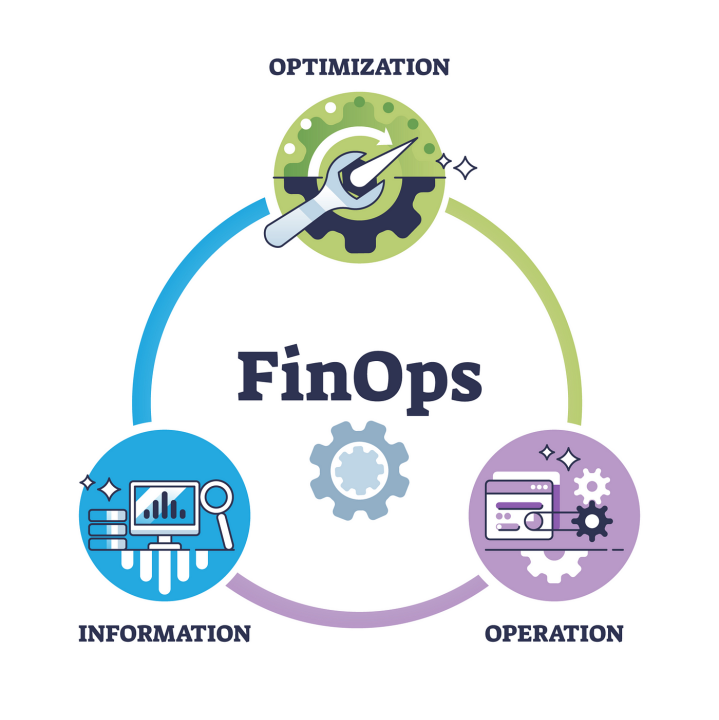
The Three Core Principles of FinOps
Although FinOps practices vary between organizations, three principles are particularly important.
1. Visibility
You cannot effectively manage what you cannot see.
B2B companies need detailed visibility into cloud spending across accounts, environments, products, teams, applications, and customers.
Useful dimensions can include:
- Cloud provider
- Business unit
- Product
- Engineering team
- Environment
- Application
- Customer
- Region
- Resource type
- Project
Cloud cost allocation and tagging are therefore foundational FinOps capabilities.
For example, instead of seeing a generic database expense, finance and engineering teams should ideally be able to determine which product or workload generated that cost.
Better visibility creates better conversations.
2. Accountability
FinOps encourages teams that use cloud resources to participate in managing their costs.
This does not mean making engineers responsible for every invoice. Instead, it means giving engineering and product teams access to meaningful cost information when they make technology decisions.
For example, an engineering team deciding between two architectural approaches should understand not only performance and development effort but also the expected infrastructure economics.
This creates a culture where cost becomes one of the engineering design considerations, alongside reliability, security, scalability, and performance.
3. Optimization
Once organizations understand cloud usage, they can identify opportunities to improve efficiency.
Optimization may involve:
- Removing unused resources
- Rightsizing compute instances
- Improving database utilization
- Optimizing storage
- Reviewing data transfer costs
- Using appropriate pricing models
- Automating non-production environments
- Improving application architecture
- Managing reserved or committed capacity
- Optimizing Kubernetes workloads
- Reducing unnecessary observability or logging costs
However, optimization should not mean blindly cutting infrastructure.
A cheaper architecture that creates downtime, slower applications, or engineering bottlenecks may ultimately cost the business more.
Effective FinOps considers cost alongside business and technical outcomes.
From Cloud Cost Management to Unit Economics
One of the most valuable FinOps capabilities for B2B companies is connecting cloud spending to unit economics.
Traditional cloud reporting might tell you:
“Our AWS bill increased by 18% this quarter.”
Unit economics asks a more useful question:
“How much does it cost to serve each customer, transaction, workspace, API request, or gigabyte processed?”
The appropriate unit depends on the business model.
For a SaaS company, it could be:
Cloud Cost per Customer = Allocated Cloud Infrastructure Cost ÷ Number of Customers
For an API business, it could be:
Cloud Cost per 1,000 API Requests = Infrastructure Cost ÷ Total API Requests × 1,000
For a data platform, it might be:
Infrastructure Cost per GB Processed = Relevant Cloud Cost ÷ GB Processed
These metrics allow businesses to connect infrastructure growth with revenue growth.
If revenue is increasing by 30% while cloud cost per customer is decreasing, the business may be achieving greater infrastructure efficiency.
If revenue grows by 30% but infrastructure cost per customer grows by 50%, leadership has a different problem to investigate.
FinOps Can Influence Product and Pricing Decisions
Cloud economics can also influence how B2B products are packaged and priced.
Consider a SaaS company with three pricing tiers. If enterprise customers generate significantly higher infrastructure costs because of storage, data processing, or API usage, a flat pricing model may not accurately reflect the economics of serving those customers.
FinOps data can help product teams evaluate questions such as:
- Should pricing include usage-based components?
- Should storage have separate limits?
- Should high-volume API usage have additional charges?
- Are certain features disproportionately expensive to operate?
- Are free-tier customers generating unsustainable infrastructure costs?
- Should expensive workloads be included in premium plans?
FinOps does not determine the pricing strategy. Instead, it provides the financial and technical data needed to make that decision more intelligently.
Building a FinOps Culture Across Engineering and Finance
FinOps works best when it is not treated as a finance-only initiative.
A successful B2B FinOps operating model usually involves multiple stakeholders.
Engineering
Engineering teams understand architecture, infrastructure, workloads, and technical trade-offs. They can identify optimization opportunities and implement changes.
Finance
Finance teams bring budgeting, forecasting, accounting, financial planning, and business-performance perspectives.
Product
Product teams can connect infrastructure economics with product features, customer usage, packaging, and pricing.
Leadership
Executives need visibility into how technology spending supports growth, margins, customer experience, and strategic priorities.
The objective is to create a shared language around cloud economics.
Instead of asking:
“Why is engineering spending so much?”
Teams can ask:
“What changed in our workload, and what business outcome did the additional spend support?”
That is a much more productive conversation.
Practical FinOps Strategies for B2B Organizations
Implementing FinOps does not require a massive transformation on day one. B2B companies can start with several practical steps.
Establish Cloud Cost Visibility
Create dashboards that show spending by account, product, environment, team, and workload.
Avoid relying exclusively on the total cloud invoice.
Improve Resource Tagging
Define a consistent tagging or labeling strategy.
Common dimensions include:
- Product
- Team
- Environment
- Customer
- Cost center
- Application
- Project
Consistent metadata makes allocation and analysis significantly easier.
Identify High-Cost Workloads
Find the applications, services, databases, and workloads responsible for the largest share of spending.
Prioritize investigation based on materiality rather than optimizing every small resource.
Track Cost Trends
Monitor cloud spending over time and compare it with business metrics.
Useful comparisons include:
- Cloud cost versus revenue
- Cloud cost versus customer growth
- Cloud cost per customer
- Cloud cost per transaction
- Cloud cost per product
- Cloud cost versus gross margin
Automate Waste Detection
Automation can identify resources that are idle, oversized, unattached, or running outside expected schedules.
For development and testing environments, automated shutdown schedules can often reduce unnecessary consumption.
Include Cost in Architecture Reviews
Cloud cost should be discussed when teams evaluate significant architectural changes.
A useful architecture review can consider:
Performance + Reliability + Security + Scalability + Cost
This prevents cost from becoming an afterthought.
FinOps and Cloud Cost Optimization Are Not the Same
The terms are sometimes used interchangeably, but they represent different concepts.
Cloud cost optimization focuses primarily on reducing or improving infrastructure costs.
FinOps is broader. It establishes the processes, accountability, data, and decision-making framework required to manage cloud economics continuously.
For example, deleting unused resources is cost optimization.
Creating a company-wide process where teams regularly analyze cloud usage, forecast spending, allocate costs, evaluate unit economics, and make informed trade-offs is FinOps.
Optimization is therefore one component of a broader FinOps practice.
Common FinOps Mistakes B2B Companies Should Avoid
FinOps initiatives can fail when organizations focus exclusively on reducing expenditure.
One common mistake is treating every cloud expense as waste. Some infrastructure costs are directly associated with growth.
Another mistake is creating reports that finance can understand but engineering teams cannot act upon. Cost data must be connected to resources and workloads that technical teams control.
Organizations can also struggle when cost allocation is inaccurate. If teams cannot trust the numbers, FinOps dashboards quickly lose credibility.
Finally, companies should avoid optimizing infrastructure at the expense of customer experience. A small reduction in infrastructure costs may not justify slower application performance or increased operational risk.
The objective is efficient cloud economics, not the lowest possible cloud bill.
How to Measure FinOps Success
FinOps success should be measured using more than absolute cloud spend.
Useful metrics can include:
- Percentage of cloud spend allocated to owners
- Forecast accuracy
- Cost per customer
- Cost per transaction
- Cloud cost as a percentage of revenue
- Percentage of unused or idle resources
- Optimization savings
- Infrastructure utilization
- Engineering adoption of cost visibility
- Gross margin trends
These metrics help organizations determine whether cloud spending is becoming more predictable, efficient, and connected to business outcomes.
The Future of FinOps for B2B
As cloud architectures become more complex, FinOps is becoming increasingly relevant to technology-led businesses.
Multi-cloud environments, Kubernetes, serverless applications, data platforms, AI workloads, and increasingly usage-based infrastructure can make cloud economics harder to understand.
At the same time, B2B companies face pressure to grow efficiently.
This means technology leaders increasingly need to answer a fundamental question:
What business value are we getting from every dollar spent on technology?
FinOps provides a framework for answering that question.
The future of FinOps is therefore not simply about cheaper infrastructure. It is about creating stronger connections between technology decisions and business outcomes.
Conclusion
For B2B companies, cloud infrastructure is no longer just an operational expense. It is part of the product, customer experience, growth engine, and economic model.
FinOps helps organizations make that relationship visible.
By combining cloud cost visibility, accountability, optimization, forecasting, and unit economics, businesses can turn infrastructure data into actionable intelligence.
The most valuable outcome is not necessarily a smaller cloud bill.
It is the ability to make better decisions about where to invest, where to optimize, how to price products, how to design systems, and how technology spending supports sustainable growth.
For B2B organizations operating in the cloud, that makes FinOps more than a cost-control practice. It becomes a strategic discipline for turning technology spending into smarter business decisions.