
Composable Commerce: Build Better B2B Buying Experiences
B2B buying has changed.
Customers no longer want to depend entirely on sales representatives, phone calls, emails, spreadsheets, or lengthy product discussions to complete a purchase. Modern B2B buyers expect digital experiences that are fast, convenient, personalized, and easy to navigate.
At the same time, B2B businesses are dealing with increasingly complex requirements.
A company may sell through a website, sales team, distributors, marketplaces, mobile applications, customer portals, and other digital channels. Different customers may have different prices, contracts, catalogs, payment terms, approval processes, and delivery requirements.
Trying to manage all of this through one large, tightly connected commerce platform can become difficult.
This is where composable commerce comes into the picture.
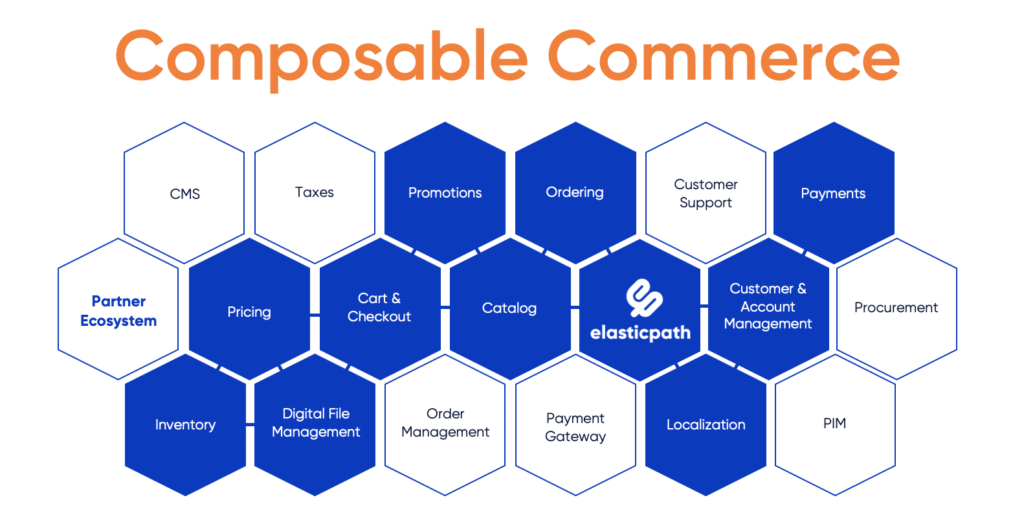
Composable commerce gives businesses the ability to build a digital commerce experience from separate, specialized components rather than depending on one system to handle everything. Companies can select the capabilities they need, connect them through APIs, and replace or improve individual components without rebuilding the entire commerce environment.
For B2B organizations, this approach can create more flexibility while making it easier to respond to changing customer expectations.
What Is Composable Commerce?
Composable commerce is an approach to building digital commerce platforms using independent components that can work together.
Instead of purchasing one large platform and using most of its built-in features, a business can choose specialized solutions for different functions.
For example, a B2B company might use:
- One system for product information
- Another for search
- Another for the shopping experience
- A separate pricing service
- A separate payment system
- A customer identity platform
- A content management system
- An order management system
- A customer data platform
These components can be connected to create one digital buying experience.
The important idea is that the business is not locked into one system for every part of commerce.
If the search experience needs improvement, the company can change the search component without necessarily replacing the entire commerce platform.
If a new payment method becomes important, the payment service can be updated independently.
This flexibility is particularly valuable in B2B commerce, where buying processes can be significantly more complicated than standard online retail.
Why B2B Commerce Needs More Flexibility
B2B commerce has its own set of challenges.
A consumer may visit an online store, select a product, enter payment information, and complete an order in a few minutes.
A B2B purchase may involve:
- Multiple buyers
- Different user roles
- Contract-specific pricing
- Volume discounts
- Customer-specific catalogs
- Purchase approvals
- Credit limits
- Tax requirements
- Multiple delivery locations
- Purchase orders
- Negotiated terms
- Sales representative involvement
- Recurring orders
The digital experience needs to support these requirements without becoming difficult to use.
At the same time, B2B buyers increasingly expect the convenience they experience in consumer digital services.
They want to find products quickly, access accurate information, see relevant pricing, check availability, place orders, track deliveries, and manage accounts without unnecessary friction.
Composable commerce can help businesses build experiences around these expectations.
Traditional Commerce Platforms vs. Composable Commerce
Traditional commerce platforms often provide many capabilities in one system.
This can make implementation easier in some situations because the business has a central platform for managing commerce operations.
However, a tightly integrated platform can also create limitations.
Changing one part of the system may affect other areas. Businesses may have to wait for platform updates or work within the capabilities offered by the vendor.
Composable commerce takes a different approach.
Instead of asking:
“Which platform can provide everything we need?”
businesses can ask:
“Which capabilities do we need, and what is the best way to connect them?”
This creates more choice.
However, composable commerce also requires stronger planning, integration, governance, and technical capabilities. It is not automatically better simply because it is more flexible.
The right approach depends on the organization’s goals, resources, existing systems, and level of digital maturity.
The Main Components of a Composable Commerce Architecture
A composable commerce environment can contain many different components.
The exact combination depends on the business.
Product Information Management
A product information management system can centralize information about products.
For B2B companies, product data can be extensive.
A product may have:
- Technical specifications
- Product codes
- Multiple units of measure
- Certifications
- Documents
- Images
- Installation instructions
- Compatibility information
- Customer-specific information
Keeping this information accurate is essential because B2B buyers often make decisions based on detailed product requirements.
Content Management
A content management system manages the content customers see across digital channels.
This can include:
- Product guides
- Articles
- Case studies
- Documentation
- Videos
- Buying guides
- Industry content
A composable approach allows the content system to operate independently from other commerce components.
Search
Search is particularly important for B2B websites with large product catalogs.
A buyer who already knows what they need may not want to browse through dozens of categories.
They may search using:
- Product codes
- Model numbers
- Technical specifications
- Product names
- Industry terminology
A dedicated search solution can help businesses create a more effective product discovery experience.
Pricing
B2B pricing is rarely simple.
Different customers may receive different prices based on contracts, volume, location, or account type.
A separate pricing service can manage these rules and provide the appropriate price to the digital experience.
This can make it easier to update pricing logic without changing the entire storefront.
Order Management
Order management handles what happens after a customer places an order.
It may involve:
- Order validation
- Inventory checks
- Fulfillment
- Shipping
- Returns
- Order tracking
Keeping order management separate from the customer-facing experience can give businesses more flexibility as their fulfillment operations change.
Payment
B2B payments may involve more than entering a card number.
Customers may use:
- Purchase orders
- Invoices
- Credit accounts
- Bank transfers
- Cards
- Other approved payment methods
A flexible commerce architecture can support different payment options based on customer requirements.
How Composable Commerce Improves B2B Buyer Experiences
The biggest reason businesses consider composable commerce is not technology.
It is the customer experience.
Modern B2B buyers want digital interactions that fit the way they work.
Personalized Pricing
Imagine two customers visiting the same B2B website.
One has a negotiated annual contract.
The other buys products at standard pricing.
A flexible commerce system can show each customer the appropriate pricing and purchasing conditions.
The experience becomes more relevant without requiring the buyer to contact sales for every transaction.
Customer-Specific Catalogs
Not every customer needs to see every product.
A manufacturer may sell thousands of products but only offer a specific selection to a particular distributor.
Composable components can help businesses create customer-specific product experiences based on account information and business rules.
Easier Reordering
B2B buyers frequently purchase the same products repeatedly.
A good digital experience should make repeat ordering simple.
Useful features can include:
- Previous orders
- Saved lists
- Quick reorder
- Frequently purchased products
- Bulk ordering
- Product codes
- Templates
These features reduce repetitive work for buyers.
Better Product Discovery
B2B catalogs can be large and complex.
Buyers may know exactly what they need but struggle to find it.
A flexible architecture can support advanced search and filtering based on the information that matters to customers.
For example, an industrial buyer may want to filter products by:
- Size
- Material
- Capacity
- Voltage
- Compatibility
- Certification
- Industry
- Availability
The better the product data and search experience, the easier it becomes for customers to make decisions.
Composable Commerce Supports Omnichannel B2B Experiences
B2B customers may interact with a company through several channels.
A buyer could discover a product through the website, speak to a sales representative, place an order through a customer portal, and track the delivery through a mobile device.
These experiences should feel connected.
Composable commerce can support this by separating the customer experience from the underlying commerce services.
The same product, pricing, customer, inventory, and order information can potentially be used across multiple channels.
This means businesses can build different digital experiences while maintaining consistent underlying information.
For example:
Website → Mobile App → Customer Portal → Sales Application
can all connect to common commerce services.
This is especially useful for B2B companies that are expanding into new digital channels.
Composable Commerce and Headless Commerce
The terms headless commerce and composable commerce are sometimes used interchangeably, but they are not exactly the same.
Headless commerce generally refers to separating the customer-facing interface from the back-end commerce functionality.
The front end can then be developed independently.
Composable commerce goes further by treating different commerce capabilities as separate components that can be selected and connected based on business needs.
In simple terms:
Headless: Separate the front end from the back end.
Composable: Build commerce from independent capabilities that can be combined and changed.
A business can use headless architecture without having a fully composable commerce strategy.
Understanding this distinction helps companies avoid treating the terms as identical.
The Role of APIs in Composable Commerce
APIs are an important part of composable commerce because different components need a way to communicate.
For example, when a customer logs into a B2B portal, the system may need to retrieve:
- Customer information
- Contract details
- Product availability
- Pricing
- Order history
- Payment options
These pieces of information may come from different systems.
APIs allow these systems to exchange information.
The customer does not need to know where the information comes from.
They simply see one connected experience.
This is one reason API design and integration planning are important when building a composable commerce environment.
Using Composable Commerce for B2B Personalization
Personalization in B2B is different from simply showing product recommendations.
A B2B customer may need a completely different buying environment.
For example, a customer may have:
- Contract-specific pricing
- A restricted product catalog
- Specific payment terms
- Multiple users
- Approval requirements
- Multiple delivery addresses
The digital experience can be personalized based on these business relationships.
A procurement employee might see products, prices, and purchasing options relevant to their organization.
A finance user might have access to invoices and payment information.
An administrator might manage users and permissions.
This creates a digital experience that reflects how B2B organizations actually purchase.
Composable Commerce and Business Agility
Markets change.
New sales channels appear. Customer expectations evolve. Companies launch new products. Payment methods change. Businesses expand into new regions.
A tightly connected platform can make these changes difficult.
A composable approach can allow businesses to change individual capabilities more independently.
For example, a company might start with a basic search solution.
As its catalog grows, it may need advanced search.
With a composable architecture, the business can potentially replace the search component without replacing every other commerce capability.
This is the core idea behind business agility in composable commerce:
Change what needs to change without rebuilding everything.
When Should a B2B Company Consider Composable Commerce?
Composable commerce can be particularly relevant when a business has complex requirements.
Signs that it may be worth considering include:
- The existing platform limits customer experience improvements.
- Different teams need different commerce capabilities.
- The business operates across multiple channels.
- Customer-specific pricing is complex.
- Product catalogs are large or highly specialized.
- The organization needs faster changes to digital experiences.
- Multiple systems already need to work together.
- The company operates across several markets.
- Existing commerce technology is difficult to extend.
- The business wants greater control over individual components.
However, complexity alone is not a reason to adopt composable commerce.
If a business has simple requirements and a conventional commerce platform meets those requirements well, adding multiple independent components may create unnecessary complexity.
The goal should be solving a business problem, not adopting an architecture because it is popular.
The Challenges of Composable Commerce
Composable commerce offers flexibility, but that flexibility comes with responsibility.
More Integration Work
Multiple systems need to communicate reliably.
The more components a business uses, the more integration points it may need to manage.
Greater Technical Complexity
A composable environment can require expertise in:
- APIs
- Cloud infrastructure
- Integration
- Data management
- Security
- Monitoring
- Software development
Organizations need the skills to manage these areas.
Vendor Management
A business may have several technology providers instead of one primary platform.
This can make vendor management more complicated.
Teams need to understand:
- Contracts
- Service levels
- Costs
- Security requirements
- Product roadmaps
- Integration dependencies
Data Consistency
Customers expect accurate information.
If pricing, inventory, product information, or customer data comes from multiple systems, businesses need strong processes for keeping information consistent.
Total Cost
Composable commerce does not necessarily cost less.
A company needs to consider:
- Software licenses
- Development
- Integration
- Infrastructure
- Maintenance
- Monitoring
- Security
- Support
The business case should focus on the value created rather than assuming that composable automatically means cheaper.
How to Build a Composable Commerce Strategy
A successful implementation should start with business requirements.
Step 1: Understand the Buyer
Identify how customers currently purchase.
Ask:
- What do they buy?
- How often do they buy?
- Who participates in the purchase?
- What information do they need?
- Where do they experience friction?
- Which activities still require sales assistance?
This provides a foundation for digital experience decisions.
Step 2: Map the Existing Technology
Document the systems currently used for:
- Products
- Customers
- Pricing
- Orders
- Payments
- Inventory
- Content
- Search
- Customer service
This helps identify where the current architecture works and where it creates limitations.
Step 3: Identify the Highest-Value Improvements
Do not start by replacing every system.
Choose areas where greater flexibility could have a measurable business impact.
For example:
Problem: Customers struggle to find products.
Potential focus: Search and product discovery.
Or:
Problem: Customer-specific pricing requires manual sales intervention.
Potential focus: Pricing and account services.
Step 4: Define the Architecture
Determine which capabilities should be separate and how they should communicate.
The architecture should be designed around actual business needs.
Step 5: Introduce Components Gradually
A gradual approach can reduce risk.
A company may begin with one capability, learn from the implementation, and expand from there.
Step 6: Measure Results
Track outcomes such as:
- Digital conversion
- Order completion
- Search success
- Self-service adoption
- Reorder frequency
- Time to launch new features
- Customer support requests
- Digital revenue
- Customer satisfaction
The metrics should connect technology changes to business outcomes.
Composable Commerce and AI
Artificial intelligence is becoming increasingly relevant to digital commerce.
In B2B, AI can potentially support:
- Product search
- Product recommendations
- Customer support
- Product discovery
- Content creation
- Sales assistance
- Demand forecasting
- Natural-language product queries
For example, instead of searching for a product using an exact product code, a buyer could describe what they need in everyday language.
A flexible commerce architecture can make it easier to introduce these capabilities without redesigning the entire commerce environment.
However, AI is only as useful as the information behind it.
Accurate product data, pricing, customer information, inventory data, and business rules remain essential.
Why Product Data Matters
Composable commerce can provide a flexible technical foundation, but poor data can still create a poor customer experience.
Consider a B2B buyer searching for a technical product.
If the product information is incomplete, inconsistent, or outdated, even the best search technology may struggle to provide the right result.
That is why businesses should treat product information as a core part of the commerce strategy.
Good product data should be:
- Accurate
- Complete
- Consistent
- Searchable
- Structured
- Relevant to the target customer
Better data makes every digital commerce component more effective.
Measuring the Success of Composable Commerce
The success of a composable commerce strategy should not be measured only by technical performance.
Business outcomes matter more.
Useful measurements include:
Digital Sales
Are more customers completing purchases through digital channels?
Self-Service
Are customers able to complete more activities without contacting sales or support?
Customer Engagement
Are customers using features such as saved lists, product search, account dashboards, and reordering?
Time to Market
Can the company launch new digital features faster?
Conversion
Are more visitors becoming buyers?
Operational Efficiency
Are employees spending less time handling routine digital transactions manually?
Customer Experience
Are buyers finding products and completing purchases more easily?
These measures help demonstrate whether architectural flexibility is producing real business value.
The Future of B2B Digital Commerce
B2B commerce is moving toward more connected and customer-focused digital experiences.
Buyers increasingly expect businesses to make purchasing as straightforward as possible while still supporting the complexity of B2B transactions.
That creates a challenge.
B2B companies need to simplify the experience without simplifying the underlying business requirements.
Composable commerce offers one approach to this problem.
By combining independent capabilities, businesses can create digital experiences that are flexible enough to support different customers, markets, products, and channels.
The architecture can evolve as customer expectations change.
Instead of rebuilding an entire platform every time a new requirement appears, businesses can potentially update the specific capability that needs to change.
Conclusion
Composable commerce is about more than using multiple technology components.
It is an approach to building digital commerce around flexibility.
For B2B organizations, that flexibility can be valuable because buying processes are often complex. Customers may have different prices, catalogs, permissions, payment methods, approval processes, and delivery requirements.
A composable approach can help businesses create digital experiences that accommodate these differences while giving technology teams more freedom to evolve individual parts of the commerce environment.
The most important starting point is not the technology.
It is the buyer.
Understand what customers need, identify where the current digital experience creates friction, examine the systems supporting that experience, and then decide where greater flexibility can create measurable value.
When implemented with clear business goals, strong data, reliable integration, and appropriate technical capabilities, composable commerce can provide B2B companies with a foundation for building digital experiences that can adapt as the market changes.
The objective is simple: make B2B buying easier for customers while giving the business the flexibility to keep improving the experience.