B2B marketing has a targeting problem.
Most companies are still relying on single-source intent data and hoping it magically translates into pipeline. A prospect visits a pricing page, downloads a whitepaper, or searches for a keyword and suddenly they are treated like a hot lead.
But buying decisions in B2B tech do not work that way anymore.
A VP of Engineering researching cloud migration today may not be ready to buy for another six months. A founder comparing CRM platforms might just be gathering information for a future board discussion. Even worse, many “high-intent” actions are driven by students, competitors, consultants, or existing customers.
The result?
Marketing teams waste budget chasing weak signals while sales teams lose trust in lead quality.
This is exactly why Intent Signal Stacking is becoming one of the most important shifts in modern B2B targeting.
Instead of relying on one isolated action, smart B2B companies are combining multiple intent signals across channels, timeframes, and buying stages to build a much more accurate picture of real purchase intent.
The difference is massive.
Companies using stacked intent signals are not just generating more leads. They are identifying buyers earlier, prioritizing accounts better, shortening sales cycles, and improving conversion efficiency across the funnel.
In this article, we’ll break down:
- What Intent Signal Stacking actually means
- Why traditional intent data is failing
- The different types of signals that matter
- How B2B tech companies can build an intent stacking framework
- Common mistakes to avoid
- Practical ways to operationalize this approach across marketing and sales
If you lead growth, marketing, or revenue strategy in a B2B tech company, this is a shift you cannot afford to ignore.
What Is Intent Signal Stacking?
Intent Signal Stacking is the process of combining multiple behavioral, contextual, and engagement signals to identify accounts that are genuinely moving toward a purchase decision.
Instead of treating one activity as proof of buying intent, you layer several actions together to create confidence.
For example:
A single LinkedIn ad click means very little.
But if the same account also:
- Visits your pricing page twice
- Searches for competitor alternatives
- Attends a webinar
- Has multiple stakeholders engaging with your content
- Opens product-focused emails
- Shows increased activity from their company IP
Now you are seeing a much clearer buying pattern.
That is Intent Signal Stacking.
The key idea is simple:
One signal can be noise.
Multiple related signals create clarity.
Why Traditional Intent Data Is Losing Effectiveness
For years, B2B marketers treated intent platforms almost like magic.
Buy a third-party intent tool.
Find “surging accounts.”
Send them to SDRs.
Expect pipeline.
But many teams discovered something frustrating:
The intent looked impressive in dashboards but did not translate into revenue.
Here’s why.
Single Signals Are Easy to Misread
One website visit does not equal buying intent.
Neither does:
- One ebook download
- One ad click
- One webinar registration
- One keyword search
Modern B2B buyers consume information constantly. Much of it is exploratory, educational, or accidental.
Without context, most signals are weak predictors.
Buying Committees Are More Complex
In B2B tech, purchases rarely involve one person.
You may have:
- Technical evaluators
- Procurement
- Finance
- Security
- Department heads
- Executive sponsors
A single stakeholder engaging with content is rarely enough to indicate active buying motion.
Intent Signal Stacking becomes powerful because it identifies coordinated engagement across the account.
Privacy Changes Reduced Visibility
Cookie restrictions, privacy regulations, and tracking limitations have weakened many traditional intent models.
This means marketers need broader signal diversity rather than dependency on one tracking method.
AI Content Saturation Increased Noise
Prospects are consuming more content than ever.
AI-generated articles, automated research tools, and mass content distribution have inflated engagement metrics across industries.
More activity does not automatically mean more intent.
This is why layered context matters more now.
The Three Core Layers of Intent Signal Stacking
The best B2B companies do not rely on one type of signal.
They combine three major categories.
1. First-Party Intent Signals
These are signals from properties you directly own.
Examples include:
- Website visits
- Pricing page engagement
- Demo requests
- Webinar attendance
- Email engagement
- Product trial activity
- Chat conversations
- Content downloads
These are highly valuable because they come directly from your ecosystem.
But first-party data alone has limitations.
A visitor may not be part of your ICP.
An existing customer may inflate engagement.
A competitor may be researching you.
This is why stacking matters.
Practical Tip
Do not score all pages equally.
For example:
High-intent pages:
- Pricing
- Integrations
- Security documentation
- Product comparison pages
Lower-intent pages:
- Blog articles
- Careers page
- Press releases
Many companies still fail at this basic distinction.
2. Third-Party Intent Signals
These come from external platforms and publisher ecosystems.
Examples include:
- Review site activity
- Competitor comparison searches
- Topic consumption patterns
- Industry research engagement
- Software evaluation activity
Third-party data helps identify accounts before they visit your site.
This is extremely valuable because many buyers are already deep into research before ever contacting vendors.
Mini Case Example
Imagine a cybersecurity SaaS company targeting enterprise buyers.
They notice an account consuming:
- Zero trust security content
- Competitor comparison articles
- Cloud compliance research
- Identity access management guides
That alone is interesting.
But when the same account also:
- Visits the vendor’s pricing page
- Watches a technical demo
- Has multiple employees engaging
Now sales outreach becomes far more timely and relevant.
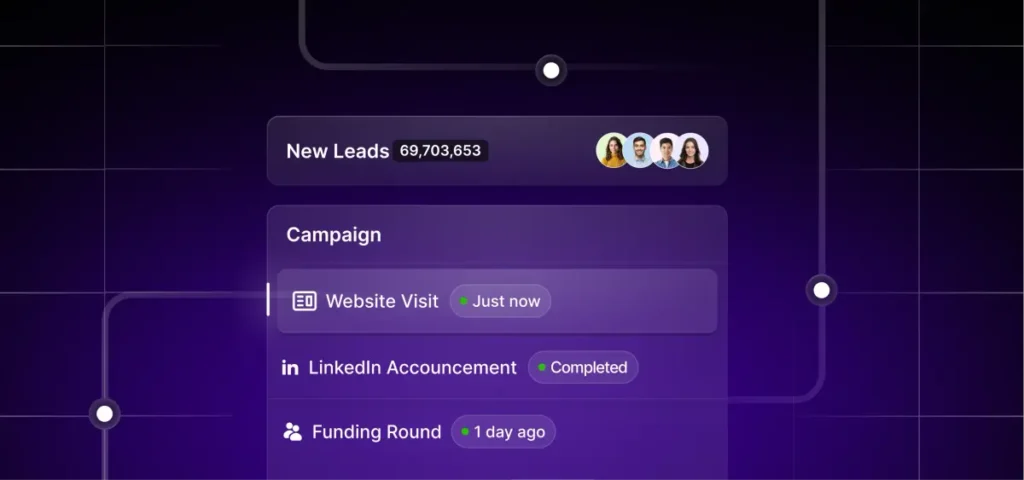
3. Operational and Contextual Signals
This is the most overlooked category in B2B marketing.
Operational signals include real-world business changes that often trigger buying decisions.
Examples include:
- New funding rounds
- Leadership hires
- Team expansion
- Geographic expansion
- Mergers and acquisitions
- Tech stack changes
- Hiring spikes
- Compliance deadlines
These signals provide timing context.
And timing is everything in B2B sales.
Contrarian Insight
Many marketers obsess over content engagement while ignoring operational triggers that often matter more.
A company hiring 25 data engineers may be a stronger buying signal for analytics infrastructure than someone downloading an ebook.
Intent without business context is incomplete.
Why Intent Signal Stacking Works Better Than Lead Scoring
Traditional lead scoring is often flawed because it rewards isolated activity.
For example:
- +10 points for webinar registration
- +5 points for email click
- +15 points for ebook download
This creates inflated lead scores disconnected from actual purchase readiness.
Intent Signal Stacking is different because it focuses on patterns, not arbitrary points.
It asks:
- Are multiple stakeholders involved?
- Is engagement increasing over time?
- Are signals aligned with buying-stage behavior?
- Is there contextual business urgency?
- Is activity concentrated around solution-related topics?
This creates a much more reliable targeting model.
The Intent Signal Stacking Framework
Here is a practical framework B2B tech companies can implement.
Step 1: Define High-Intent Behaviors
Start by identifying actions that historically correlate with pipeline creation.
Examples:
- Pricing page revisits
- Demo page engagement
- Competitor comparison consumption
- Product documentation views
- Security compliance page visits
- Trial activation
- ROI calculator usage
Look at closed-won deals and reverse engineer common patterns.
This is where many companies should start instead of blindly copying generic scoring templates.
Step 2: Group Signals by Buying Stage
Not all intent signals mean the same thing.
Early-Stage Signals
- Educational blog consumption
- Industry research
- Thought leadership engagement
- Social interactions
Mid-Stage Signals
- Webinar attendance
- Product-focused content
- Competitor research
- Solution comparisons
Late-Stage Signals
- Pricing visits
- Demo requests
- Technical documentation
- Procurement-related engagement
Stacking becomes far more effective when you understand sequencing.
Step 3: Add Account-Level Intelligence
This is critical.
Do not evaluate intent at the individual lead level only.
Look at:
- Total account engagement
- Number of stakeholders involved
- Department diversity
- Engagement velocity
- Repeat activity
A single highly engaged contact is less valuable than five moderately engaged stakeholders across departments.
Enterprise buying is collaborative.
Your targeting should reflect that.
Step 4: Layer in Business Triggers
Now combine engagement data with operational context.
Examples:
- Funding announcement + pricing page visits
- New CIO hire + infrastructure research
- Expansion hiring + workflow automation engagement
- Regulatory changes + compliance content consumption
This dramatically improves prioritization.
Step 5: Align Sales Outreach to Signal Patterns
Most SDR outreach fails because it ignores behavioral context.
Bad outreach:
“Just checking if you need our solution.”
Better outreach:
“Noticed your team has been evaluating cloud security frameworks while scaling infrastructure hiring. We recently helped a similar company reduce deployment risk during expansion.”
Specificity increases credibility.
Common Mistakes in Intent Signal Stacking
Even sophisticated B2B teams make these mistakes.
Mistake #1: Over-Relying on Third-Party Intent Vendors
Third-party data is useful.
It is not magic.
Many intent providers overinflate “surging topics” without enough precision.
Use third-party intent as one layer, not the entire strategy.
Mistake #2: Ignoring Time Windows
Intent decays quickly.
A pricing page visit from six months ago is not useful.
Strong intent stacking depends on recency and momentum.
Pay attention to:
- Frequency
- Velocity
- Consistency
- Signal clustering
Recent coordinated activity matters most.
Mistake #3: Treating All Accounts Equally
Not every engaged account deserves sales attention.
An SMB account showing strong intent may still be lower priority than a lightly engaged enterprise account with massive expansion potential.
Intent must be filtered through ICP quality.
Mistake #4: Measuring Activity Instead of Buying Readiness
More engagement is not always better.
Sometimes buyers close quickly with minimal content consumption.
Other times high engagement signals confusion rather than readiness.
Intent stacking should improve judgment, not replace it.
How Leading B2B Tech Companies Use Intent Signal Stacking
The strongest GTM teams are operationalizing intent across departments.
Here’s what that looks like.
Marketing Teams
Marketing uses stacked intent to:
- Prioritize ABM campaigns
- Personalize nurture sequences
- Trigger retargeting workflows
- Tailor content recommendations
- Optimize budget allocation
Instead of broad targeting, campaigns become more focused and contextual.
Sales Teams
Sales teams use stacked intent to:
- Prioritize outbound accounts
- Personalize messaging
- Improve timing
- Identify buying committees
- Reduce wasted prospecting
This improves SDR efficiency significantly.
Customer Success Teams
This is often overlooked.
Existing customer intent signals can identify:
- Expansion opportunities
- Upsell readiness
- Renewal risk
- Product adoption gaps
Intent stacking is not only for net-new acquisition.
A Realistic Example of Intent Signal Stacking in Action
Let’s say you run a DevOps automation platform.
Here’s how a stacked intent scenario may develop.
Week 1
An engineering manager downloads a Kubernetes scaling guide.
Weak signal alone.
Week 2
Three employees from the same company:
- Visit integration pages
- Watch deployment automation videos
- Search competitor alternatives
Signal strength increases.
Week 3
The company announces Series B funding and opens hiring for 20 infrastructure roles.
Now urgency context appears.
Week 4
The VP of Engineering visits pricing pages twice and attends a technical webinar.
At this point, outreach timing becomes highly strategic.
This is far more actionable than isolated lead scoring.
The Future of Intent Signal Stacking
The next evolution is not just more signals.
It is better interpretation.
AI tools are making signal collection easier for everyone. That means competitive advantage will come from understanding patterns better than competitors.
The winners will:
- Combine qualitative and quantitative signals
- Connect intent to business timing
- Personalize outreach intelligently
- Prioritize account-level behavior
- Build tighter sales-marketing alignment
The companies still relying on simplistic MQL models will fall behind.
Quick Checklist for Implementing Intent Signal Stacking
Use this checklist to assess your current strategy.
Intent Signal Stacking Checklist
- Are you combining first-party and third-party intent?
- Are you tracking account-level engagement?
- Do you distinguish between early and late-stage signals?
- Are operational triggers included?
- Are signals weighted by buying relevance?
- Do sales teams see contextual insights?
- Are you monitoring engagement velocity?
- Are your ICP filters integrated?
- Are signals refreshed regularly?
- Is outreach personalized to intent patterns?
If several answers are “no” your targeting model likely needs modernization.
A Simple Intent Signal Stacking Model for B2B Teams
Here is a practical lightweight framework.
The 4D Framework
1. Detect
Capture engagement across channels.
2. Distinguish
Separate weak signals from meaningful patterns.
3. Deepen
Add business context and account intelligence.
4. Deploy
Trigger personalized sales and marketing actions.
Simple frameworks outperform overly complicated systems.
Especially in fast-moving B2B environments.
Secondary Keywords Naturally Connected to Intent Signal Stacking
To strengthen SEO relevance and topical authority, this article naturally connects to concepts like:
- B2B intent data
- Account-based marketing
- Buyer intent signals
- Revenue intelligence
- Sales and marketing alignment
- Predictive lead scoring
- GTM strategy
- Demand generation
- B2B audience targeting
- Pipeline acceleration
These topics reinforce search intent without forcing keyword stuffing.
Final Thoughts: Intent Alone Is Not Enough
The biggest mistake in modern B2B targeting is assuming more data automatically creates better decisions.
It does not.
Most companies are drowning in disconnected signals while starving for clarity.
Intent Signal Stacking changes the game because it shifts focus from isolated actions to meaningful behavioral patterns.
That is where real buying insight lives.
The future of B2B growth will belong to companies that can:
- Recognize intent earlier
- Interpret context more accurately
- Coordinate sales and marketing around signal intelligence
- Personalize engagement without becoming intrusive
The goal is not just generating more leads.
It is identifying the right accounts at the right moment with the right message.
That is the real evolution of B2B targeting.
And it is already underway.