Artificial intelligence in the enterprise has become closely associated with scale. Bigger models, larger datasets and increasingly sophisticated capabilities have dominated the conversation around generative AI. For many businesses, the assumption has been straightforward: if a larger language model can understand more, reason better and handle more complex tasks then it must also be the better choice.
That assumption is increasingly being challenged.
Small Language Models, or SLMs, are emerging as a compelling alternative for businesses that need AI to be fast, focused, cost-efficient and easier to control. Rather than trying to solve every possible problem, an SLM can be designed or fine-tuned for a narrower set of business tasks. In the right B2B environment, that specialization can translate into greater business value than deploying a much larger general-purpose model.
The question for enterprises is no longer simply, “How powerful can our AI be?”
It is becoming, “How much intelligence do we actually need for this job?”
For many B2B applications, the answer may be less than expected.
What Are Small Language Models?
Small Language Models are AI models with significantly fewer parameters than the largest language models available today. While there is no universal parameter threshold that defines an SLM, the category generally refers to compact models optimized for specific tasks, environments or resource constraints.
Large language models are designed to be broadly capable. They can write content, summarize documents, answer questions, reason through problems, generate code and perform many other tasks from a single model.
SLMs take a different approach.
Instead of maximizing general-purpose capability, they can prioritize efficiency and specialization. An SLM might be trained or fine-tuned to classify customer support tickets, extract information from invoices, summarize internal documents, route sales leads or answer questions about a specific product catalog.
That narrower scope can be a significant advantage in B2B environments.
Businesses rarely need an AI system that can do everything. They need systems that can reliably perform particular tasks within specific workflows.
If an AI model is being used to classify thousands of customer requests every day, for example, it may not need the broad reasoning capabilities of the largest available model. It needs to understand the company’s terminology, identify the right category and produce a consistent result.
That is precisely where smaller models can become attractive.
Why Bigger Does Not Always Mean Better
The appeal of larger AI models is easy to understand. More capable models can handle a wider range of instructions and often perform better on complex reasoning tasks.
But enterprise AI is not judged solely by benchmark performance.
Businesses also care about cost, speed, security, reliability, integration and operational control.
A model that is 10 percent better at a generic benchmark may not create more value if it costs several times more to operate, introduces higher latency or requires sensitive data to leave a controlled environment.
Consider a B2B organization processing millions of documents or transactions each month. If a relatively small model can perform a particular classification or extraction task with sufficient accuracy, using a larger model for every request may create unnecessary expense.
The goal should not be maximum intelligence at any cost.
The goal should be optimal intelligence for the business problem.
This distinction is important because enterprise AI workloads are often repetitive. Customer support classification, document processing, product categorization and information extraction can involve large volumes of similar tasks.
When the problem is narrow and predictable, a specialized model can be extremely effective.
The Economics of Smaller AI
Cost is one of the strongest arguments for SLM adoption.
Running AI at enterprise scale can become expensive when every request is sent to a large model. Costs can come from inference, infrastructure, API usage, data transfer and the engineering resources required to operate the system.
Smaller models can reduce several of these costs.
Because they require fewer computational resources, they can often run on less expensive infrastructure. In some cases they can also run closer to the point where data is generated, including on private servers or edge devices.
This creates an important economic opportunity.
Imagine a company that processes 20 million customer service messages annually. Suppose the business uses an AI model primarily to classify each message into categories such as billing, technical support, account access or product questions.
The company does not necessarily need a model capable of writing a legal brief or solving advanced mathematical problems for every message.
A smaller model trained for support classification may be enough.
Even a modest reduction in inference cost can become substantial at millions of transactions. The financial benefit becomes even more attractive when the model also reduces infrastructure requirements and improves response times.
This is where the phrase “smaller AI, bigger business value” becomes more than a slogan.
Efficiency multiplied by scale can create significant returns.
Speed Matters in Business
Latency is another area where SLMs can outperform larger alternatives.
In consumer applications, an extra second of response time might be inconvenient. In enterprise workflows, latency can affect productivity, customer experience and transaction throughput.
Consider an AI system assisting employees during a sales call. The system may need to classify customer questions, retrieve relevant product information and recommend the next action.
If every small task requires a request to a large model hosted remotely, delays can accumulate.
A smaller model can potentially perform specific tasks much faster, particularly when it runs locally or within the company’s own infrastructure.
This makes SLMs particularly interesting for real-time applications.
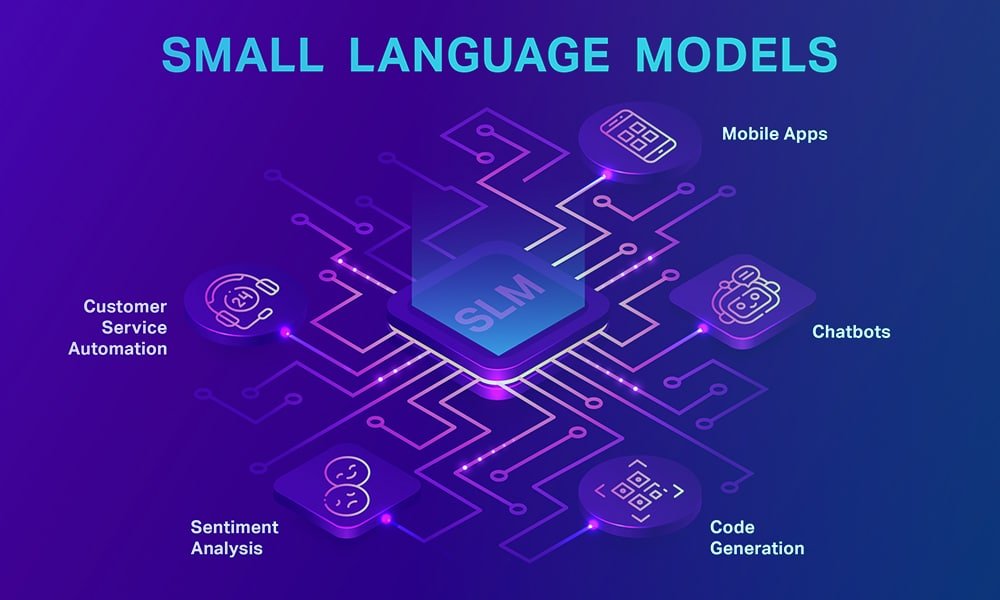
Examples include:
- Customer service routing
- Fraud and anomaly detection
- Sales lead classification
- Real-time document processing
- Industrial monitoring
- Internal search
- Email classification
- Workflow automation
- Voice and conversational interfaces
- Field service applications
In these situations, speed is not merely a technical metric. It can become a business advantage.
Privacy and Data Governance
Data governance is one of the biggest concerns surrounding enterprise AI.
B2B organizations often work with confidential information including financial records, customer data, contracts, product specifications and internal communications.
Sending every AI request to an external model can introduce additional security, compliance and governance considerations.
Smaller models offer another architectural option.
Depending on the model and infrastructure, an SLM can potentially be deployed inside a company’s private cloud, data center or controlled computing environment. This can provide organizations with greater control over where data is processed and how AI systems interact with sensitive information.
For highly regulated industries, this can be particularly valuable.
Healthcare organizations, financial institutions, manufacturers and government contractors may have strict requirements around data handling. A smaller model that can operate within an organization’s existing security boundary may make certain AI applications easier to deploy.
That does not mean SLMs automatically solve every security or compliance challenge.
They still require proper access controls, monitoring, model governance and data protection. However, their smaller infrastructure footprint can make certain deployment strategies more practical.
SLMs Can Be Easier to Customize
One of the most important advantages of smaller models is specialization.
A general-purpose model has to accommodate a huge range of possible users and tasks. An enterprise model can instead focus on the language, processes and requirements of a particular business.
For example, a logistics company could develop an AI system focused on shipment documentation. The model could learn the company’s terminology, identify relevant fields and flag common documentation errors.
A software company could use an SLM to classify incoming technical support requests based on product, severity and issue type.
A manufacturer could use a smaller model to analyze maintenance reports and categorize equipment problems.
In each case, the value comes from domain specialization.
The model does not need to know everything.
It needs to know enough about one important business process to perform that process reliably.
This creates an important shift in how companies should think about AI development. Instead of asking whether one model can power the entire organization, businesses can consider whether different models should handle different parts of the workflow.
The Rise of AI Model Portfolios
The future of enterprise AI may not belong exclusively to either large models or small models.
It may belong to a portfolio.
A business could use a large language model for complex reasoning, strategic analysis and sophisticated content generation while using smaller models for high-volume operational tasks.
For example, a B2B sales organization might use:
- An SLM to classify incoming leads
- An SLM to extract information from CRM notes
- An SLM to identify customer intent
- A larger model to create account strategies
- A larger model to generate personalized proposals
- A retrieval system to provide accurate product information
This approach treats AI models as specialized components rather than universal solutions.
It can also improve cost management.
There is little reason to use the most expensive model for every step of a workflow if a smaller model can handle routine operations.
Where SLMs Deliver the Most Value
SLMs are especially well suited to tasks with clear inputs, defined outputs and repeatable patterns.
1. Classification
Classification is one of the strongest SLM use cases.
Companies can use smaller models to categorize support tickets, sales leads, documents, transactions and internal requests.
Because the output space is constrained, the model does not need unlimited generative capabilities.
2. Information Extraction
Businesses process enormous quantities of structured and unstructured documents.
An SLM can help identify information such as invoice numbers, contract terms, customer names, dates, product codes and other relevant fields.
Automating extraction can reduce manual work while accelerating downstream processes.
3. Customer Support Routing
Not every customer interaction needs a sophisticated conversational AI system.
A smaller model can determine why a customer is contacting the business and route the request to the correct team.
For high-volume support operations, this can have a meaningful impact on efficiency.
4. Internal Knowledge Applications
Organizations can deploy smaller models for targeted internal knowledge systems.
An SLM combined with retrieval capabilities could help employees find information about company processes, product specifications or internal policies.
The model’s role does not necessarily need to be generating everything from scratch. It can interpret the question, identify relevant information and provide a concise response based on approved sources.
5. Edge and Local Applications
Some business environments cannot depend on constant connectivity to cloud AI services.
Factories, warehouses, retail locations and field operations may benefit from models that can operate closer to the user or device.
Smaller models make these deployments more feasible because their resource requirements can be significantly lower.
The Accuracy Question
One of the biggest objections to SLM adoption is accuracy.
It is a valid concern.
A smaller model may struggle with complex reasoning, ambiguous instructions or tasks requiring broad world knowledge. Businesses should not assume that a smaller model will automatically perform as well as a larger model across every scenario.
The right question is more specific:
“Is the SLM accurate enough for this particular task?”
Enterprise AI systems should be evaluated against business requirements rather than general benchmarks alone.
For a document classification workflow, 98 percent accuracy might be excellent. For a high-stakes decision-making application, the acceptable threshold could be dramatically different.
Companies should therefore establish clear evaluation criteria before selecting a model.
These can include:
- Accuracy
- Hallucination rate
- Response time
- Cost per transaction
- Failure rate
- Human escalation rate
- Data privacy requirements
- Availability
- Maintainability
The best model is the one that meets the required business threshold at an acceptable total cost.
SLMs Are Not a Replacement for Large Models
The growing interest in SLMs should not be interpreted as the end of large language models.
Large models remain highly valuable for complex tasks.
They can be particularly useful when a problem involves open-ended reasoning, nuanced language understanding, multi-step analysis or broad knowledge.
Instead, SLMs should be viewed as another layer in the enterprise AI stack.
A useful way to think about the relationship is this:
Large models provide breadth.
Small models provide efficiency.
When combined strategically, they can create a more effective AI architecture.
A company might use a smaller model as the first layer of an AI pipeline. Straightforward requests can be handled immediately. More complicated requests can be escalated to a larger model.
This routing approach can reduce costs without sacrificing access to advanced capabilities when they are genuinely needed.
How Businesses Should Evaluate an SLM
Organizations considering smaller models should begin with business processes rather than model specifications.
Start by identifying repetitive AI workloads.
Look for processes where employees repeatedly perform similar activities such as sorting, extracting, summarizing, routing or categorizing information.
Then measure the current cost of those processes.
How many transactions occur each month? How much employee time is involved? How much does each transaction cost? What is the impact of delays or errors?
Once the business case is clear, evaluate whether an SLM can meet the required performance level.
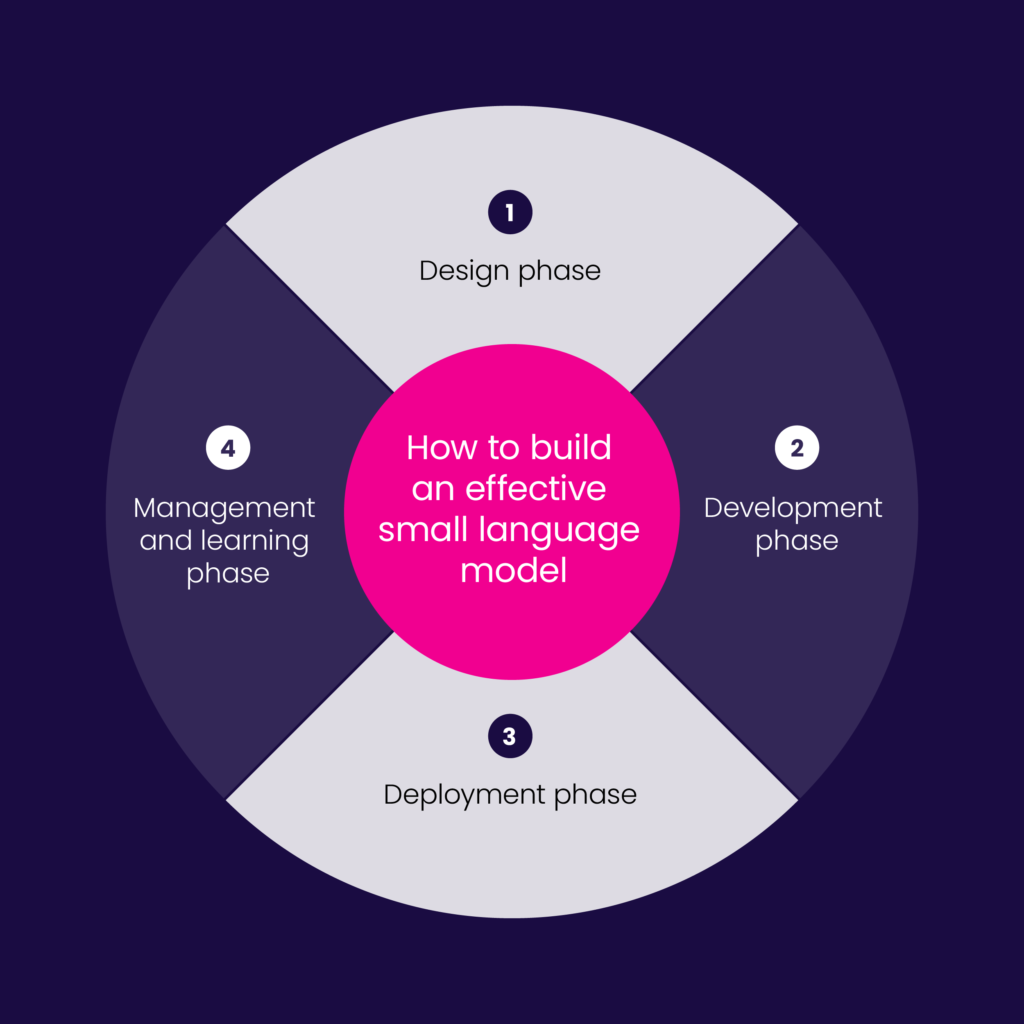
A practical evaluation framework could include five stages:
First, define the task.
Be precise about what the model needs to do and what constitutes a successful outcome.
Second, create a representative test dataset.
Use real-world examples that reflect the complexity and variation of production data.
Third, compare multiple models.
Evaluate both smaller and larger models against the same criteria.
Fourth, calculate total cost.
Look beyond model pricing. Include infrastructure, engineering, monitoring, maintenance and human review.
Fifth, run a controlled pilot.
Test the model in a limited production environment before expanding the deployment.
This approach prevents businesses from choosing models based purely on hype or benchmark rankings.
The Strategic Advantage of Smaller AI
There is a broader strategic lesson behind the rise of SLMs.
Enterprise AI is moving from experimentation toward operationalization.
During the early stages of generative AI adoption, companies often focused on what AI could theoretically do. As organizations move deeper into implementation, the emphasis is shifting toward what AI can do reliably, affordably and repeatedly.
That change favors smaller specialized models.
An enterprise does not create value simply by having access to advanced AI.
It creates value when AI improves a business process.
If an SLM can automate a task that previously required thousands of hours of human effort, reduce processing time from minutes to seconds or lower the cost of millions of transactions then its smaller size becomes a strength rather than a limitation.
The competitive advantage comes from matching the right level of intelligence to the right business problem.
The Future Is Smaller Than It Looks
The AI industry has spent years pursuing bigger models.
That pursuit has produced remarkable similar to how businesses already use different software systems for different jobs. A company does not need one application to perform accounting engines embedded inside business workflows. They can classify, extract, route, summarize and automate high-volume processes without requiring the computational advances in language understanding, reasoning and generation. But the next phase of enterprise AI may be defined less by model size and more by model fit.
Businesses will increasingly ask which model should handle which task.
Some problems will require large models. Others will benefit from small specialized models. Many enterprise workflows will use both.
This is similar to how businesses already use different software systems for different jobs. A company does not need one application to perform accounting, manage customer relationships, process payroll and monitor infrastructure. It uses specialized tools that work together.
AI architectures can follow the same principle.
Small Language Models can become specialized engines embedded inside business workflows. They can classify, extract, route, summarize and automate high-volume processes without requiring the computational footprint of a massive general-purpose model.
For B2B organizations, that can translate into lower costs, faster responses, stronger data control and more scalable automation.
The most important AI model may not be the biggest one.
It may be the one that solves a specific business problem well enough, cheaply enough and reliably enough to make a measurable difference.
That is the real promise of Small Language Models.
Not smaller AI for its own sake, but smarter AI economics.
And in enterprise technology, that distinction can create some very big business value.